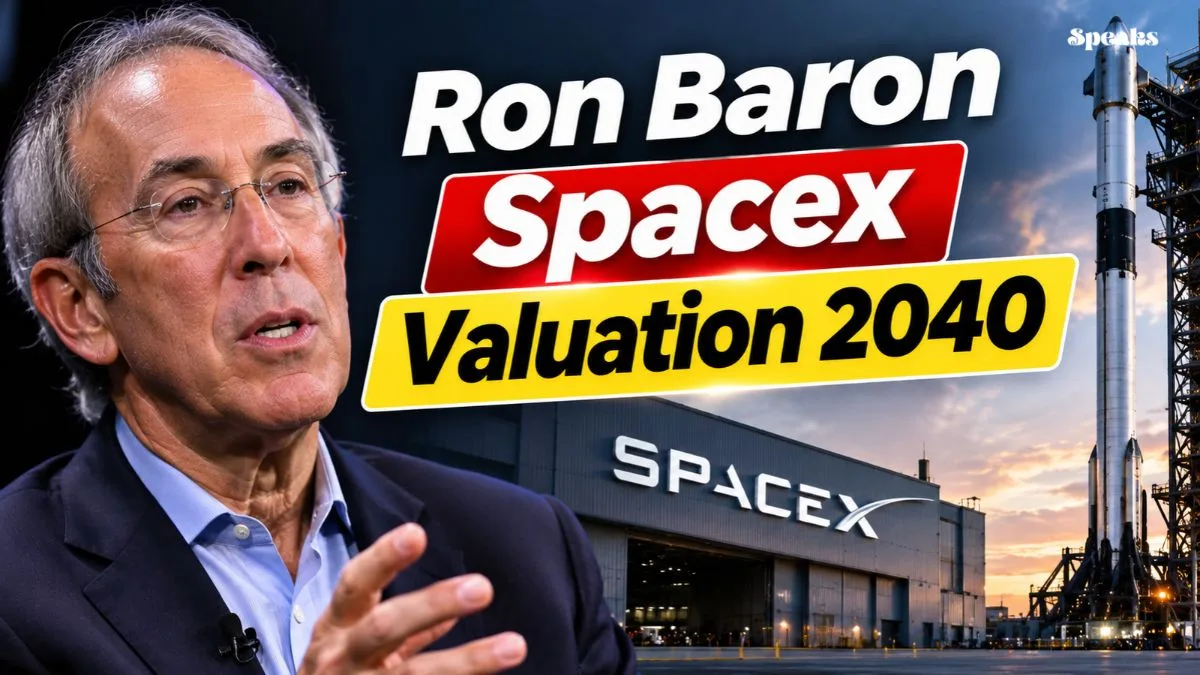
Billionaire investor Ron Baron believes SpaceX could become one of the most valuable companies in the world by 2040, with a potential market valuation of $30 trillion. However, reaching that milestone would require years of exceptional growth from Elon Musk’s space and satellite technology business.
Baron, founder and chief executive of Baron Capital, has been an early investor in SpaceX and remains highly optimistic about its long-term prospects. His forecast comes as the company expands beyond rocket launches into satellite internet, artificial intelligence infrastructure and other emerging space-based services.
The latest estimate has drawn attention because SpaceX is already valued in the trillions. Moving from its current market capitalization to $30 trillion would require substantial business expansion and sustained investor confidence over the next 14 years.
Ron Baron SpaceX Valuation 2040: The $30 Trillion Forecast
According to the report, SpaceX was trading at approximately $141 per share, giving it a market capitalization of around $1.92 trillion. A rise to $30 trillion would represent an increase of approximately 1,460% from that starting valuation.
The scale of the prediction becomes clearer when annual growth is considered. If SpaceX reaches the $30 trillion mark in 2040, its valuation would need to increase by roughly 21.7% annually over 14 years, assuming the starting market value remains comparable.
That is an ambitious target for a company that has already entered the trillion-dollar category. Sustaining growth above 20% annually for more than a decade is difficult, particularly when a business is already worth close to $2 trillion.
Baron’s outlook reflects his confidence in the markets SpaceX could serve rather than a guarantee that the company will achieve the projected valuation.
Why Ron Baron Believes SpaceX Can Become a $30 Trillion Company
Baron’s investment case is closely connected to Elon Musk’s long-term plans for SpaceX. The company is no longer focused solely on launching rockets and transporting cargo into orbit.
Its business opportunities include reusable launch systems, global satellite connectivity, government and commercial space services, and potentially large-scale computing infrastructure in orbit.
These markets could expand significantly if the cost of reaching space continues to decline and demand for satellite-based services increases.
Baron has also pointed to Musk’s broader ambitions in artificial intelligence and space infrastructure. In his view, these businesses could create economic opportunities that extend well beyond the traditional aerospace industry.
However, the company’s ability to turn those ambitions into profitable operations will be central to whether its valuation can grow at the pace he expects.
Starlink Could Become One of SpaceX’s Biggest Growth Engines
Starlink is one of the most important parts of the long-term SpaceX investment story.
The satellite internet service is designed to provide broadband connectivity in areas where traditional fiber and mobile networks are difficult or expensive to deploy. Its potential customer base includes households, businesses, airlines, ships and government organisations.
As the satellite network expands, Starlink could generate revenue from a wider range of customers and markets. Its ability to serve remote locations also gives it a potential advantage in regions with limited internet infrastructure.
For investors evaluating the Ron Baron SpaceX valuation 2040 prediction, Starlink’s commercial performance will be particularly important.
A larger subscriber base, higher average revenue per customer and additional enterprise services could strengthen the business. But competition, regulatory approvals, network capacity and the cost of maintaining satellites remain important considerations.
Starship Could Change SpaceX’s Long-Term Economics
Another major part of SpaceX’s growth strategy is Starship, the company’s next-generation launch vehicle.
The system is being developed with the goal of carrying people and cargo into space while making the launch process more reusable. If SpaceX can achieve reliable and frequent operations, it could potentially reduce the cost of transporting payloads into orbit.
Lower launch costs could support several business opportunities, including larger satellite networks, commercial space stations, lunar missions and future exploration projects.
Starship could also help SpaceX deploy additional Starlink satellites more efficiently. That would connect the company’s launch business directly with its satellite internet operations.
However, developing a fully reusable launch system at scale remains a major engineering challenge. Technical setbacks, safety requirements and regulatory approvals could affect the timeline and financial returns.
Space-Based Data Centers Add Another Layer to the SpaceX Valuation
Baron’s broader vision also includes data centers operating in space.
Artificial intelligence companies require increasing amounts of computing capacity, electricity and cooling infrastructure. Building and operating large data centers on Earth can involve substantial power requirements, land constraints and infrastructure costs.
Space-based computing infrastructure could eventually offer a different approach if launch costs, satellite technology and orbital operations become economically practical.
SpaceX’s launch capabilities and satellite network could potentially provide an advantage in developing such infrastructure. The idea remains an emerging opportunity, however, rather than an established revenue stream comparable to Starlink.
For a $30 trillion valuation to become realistic, investors would need evidence that these projects can move beyond ambitious plans and generate meaningful commercial returns.
How Much Growth Does SpaceX Need to Reach $30 Trillion?
The valuation target involves a substantial increase from the approximately $1.92 trillion market capitalization cited in the report.
| Valuation measure | Approximate figure |
|---|---|
| Starting market capitalization | $1.92 trillion |
| Target valuation | $30 trillion |
| Required total increase | 1,460% |
| Annualized growth over 14 years | 21.7% |
| Annualized growth over 10 years | 31.6% |
These figures illustrate how demanding Baron’s forecast is. Reaching $30 trillion by 2040 would require SpaceX to deliver strong growth across multiple businesses while maintaining investor confidence over an extended period.
The calculations also assume no major share dilution. If the company issues additional shares, the relationship between market capitalization and the return earned by existing shareholders could change.
The actual investment outcome would also depend on the price investors pay, future earnings, cash flow, capital requirements and the company’s eventual share structure.
Could SpaceX’s Valuation Rise Further Through a Tesla Combination?
The report also discusses speculation surrounding possible merger talks between SpaceX and Tesla.
A combination of the two Musk-led businesses could create a significantly larger corporate structure, potentially changing how investors assess the $30 trillion target.
However, merger speculation should not be treated as a completed transaction or a confirmed business plan. Any potential deal would involve complex financial, regulatory and operational considerations.
Investors would also need to examine how the companies’ different businesses, liabilities, capital requirements and shareholder interests would be combined.
For now, SpaceX’s standalone growth in satellite connectivity, launch services and emerging technology remains the more direct basis for assessing its long-term prospects.
Is Ron Baron’s SpaceX Prediction Realistic for Long-Term Investors?
A $30 trillion valuation by 2040 is possible only if SpaceX continues to expand at an extraordinary rate. The company would need to execute across several major markets while overcoming technical, financial and competitive challenges.
Its existing operations provide a foundation, but future opportunities such as orbital data centers and large-scale space infrastructure remain uncertain. The difference between a promising technology and a profitable business can take years to establish.
Baron’s forecast is therefore best understood as a long-term investment thesis, not a guaranteed outcome or an official SpaceX valuation target.
Investors following the company will likely focus on Starlink’s revenue growth, Starship’s development progress, launch economics and the commercial viability of its emerging AI infrastructure plans.