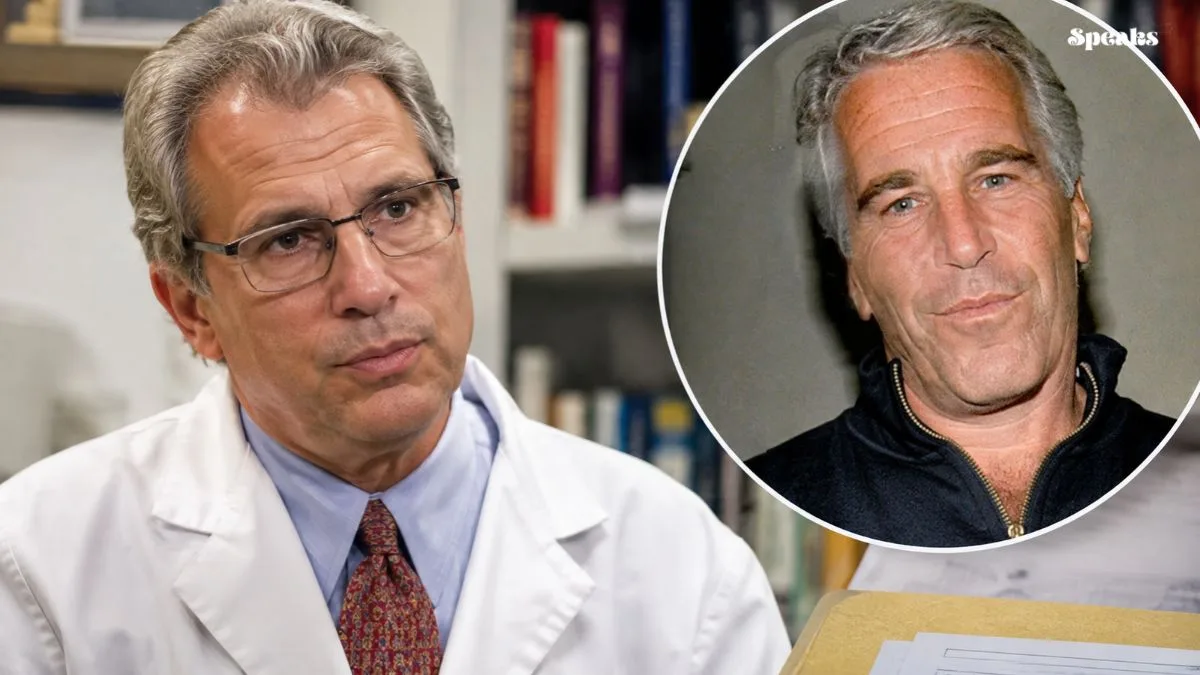
A new forensic review by Dr. Michael Freeman has raised questions about the official cause of Jeffrey Epstein’s death, with the expert arguing that the injuries documented during the 2019 autopsy are more consistent with homicide than suicide.
Freeman presented his findings in London on November 16, 2026, after spending months examining autopsy records and photographs supplied by Epstein’s brother, Mark Epstein. His assessment directly challenges the New York City medical examiner’s ruling that Epstein died by suicide.
The new analysis has attracted attention because Epstein died in federal custody while awaiting trial on sex trafficking charges. However, Freeman’s conclusion remains disputed and has not changed the official determination.
Who Is Dr. Michael Freeman?
Dr. Michael Freeman is a forensic medicine expert whose work focuses on death investigations, injury analysis and the use of scientific methods in forensic practice.
He is editor-in-chief of the Journal of Forensic and Legal Medicine and has held academic appointments in forensic medicine and epidemiology. His professional background includes expert testimony in criminal and civil cases, including investigations involving deaths in custody.
Freeman has also worked with legal and medical institutions on reviews of deaths involving law enforcement custody. His experience has brought additional attention to his assessment of Epstein’s autopsy evidence.
For this review, Freeman worked with Anders Eriksson, a professor of forensic medicine at Umeå University in Sweden, and Itiel Dror, a researcher whose work examines bias in forensic decision-making.
Why Dr. Michael Freeman Disputes the Epstein Suicide Ruling
Freeman’s central argument concerns the pattern of injuries documented on Epstein’s neck and other parts of his body.
After examining photographs and medical records, he questioned whether the marks on Epstein’s neck could be fully explained by the hanging scenario accepted by the medical examiner. He argued that the injury pattern included features that required a different explanation.
One issue highlighted in the review was the presence of more than one mark around the neck. Freeman said the location and direction of the marks did not fit the mechanism he would expect from the ligature arrangement described in the official account.
He also pointed to injuries involving Epstein’s left shoulder and back. Freeman argued that these findings were not adequately explained by the suicide-hanging interpretation.
His assessment included a biomechanical reconstruction using three-dimensional models designed to examine how the injuries could have occurred. The models were based on the available photographs, medical records and an account of how Epstein’s body was found.
What the Forensic Review Says About Epstein’s Neck Injuries
The neck injuries are central to Freeman’s challenge to the official ruling. He focused on the shape, direction and appearance of the ligature marks visible in the autopsy photographs.
Freeman argued that some of the marks appeared inconsistent with the hanging explanation. He proposed that pressure from a narrow, knotted fabric ligature could better account for the pattern he observed.
He also questioned whether the fabric evidence recovered from Epstein’s cell had been adequately connected to the injuries documented during the autopsy.
These observations form part of Freeman’s homicide theory. They do not, by themselves, establish who may have been involved or prove that another person entered Epstein’s cell.
The distinction matters because forensic findings must be assessed alongside the full medical record, scene evidence and investigative findings.
Why Freeman Believes Other Injuries Need Further Explanation
Beyond the neck marks, Freeman identified injuries that he said deserved closer examination, including deep soft-tissue bleeding in the left shoulder and an injury to the back.
He argued that these findings could be consistent with blunt-force trauma or a physical struggle. The review also discussed marks on the face and possible fingernail-related abrasions near the neck.
Freeman said the combined pattern was more consistent with an assault followed by ligature strangulation than with the official explanation of suicide by hanging.
However, interpreting injuries after death can be complex. A forensic opinion must account for the position of the body, the circumstances of death, possible movement and the limitations of photographs and medical documentation.
Freeman did not personally examine Epstein’s body. His assessment relied on records and images made available to him, a limitation readers should consider when evaluating the findings.
New Analysis Does Not Change the Official Epstein Death Ruling
The New York City Office of Chief Medical Examiner ruled in 2019 that Epstein died by suicide by hanging. The office has continued to stand by that determination following the release of Freeman’s assessment.
A spokesperson for the medical examiner’s office said the agency stood by its original conclusion. The office did not publicly adopt Freeman’s interpretation of the injuries.
The official finding has also received support from previous federal reviews. The FBI found no evidence of criminality in Epstein’s death, while a 2023 report by the Department of Justice Office of Inspector General documented serious failures at the jail but found no evidence establishing that another person caused his death.
A separate review by The New York Times in June 2026 examined extensive records and Epstein’s handwritten jail notes. It reported evidence that he had shown signs of suicidal intent before his death.
The newspaper also reported that forensic specialists it consulted did not believe the medical evidence alone could conclusively settle whether the death was suicide or homicide.
Why the Forensic Findings Remain Disputed
Forensic pathology involves interpreting physical evidence in the context of medical findings and the circumstances surrounding a death. Some injuries, particularly those involving the neck, can be difficult to interpret because different mechanisms may produce overlapping patterns.
That makes independent review important, but it also means a single expert’s conclusion should not be treated as a final determination.
Freeman’s analysis has not yet been published in a peer-reviewed academic journal. He said a journal declined the report, and he planned to submit the work again.
Peer review is one way scientific researchers evaluate the methods, evidence and reasoning behind a study. Until that process takes place, the findings should be understood as an expert assessment rather than an established scientific consensus.
The disagreement also highlights the difference between questioning an official investigation and proving an alternative explanation. Identifying unanswered questions does not automatically establish homicide.
What Happened to Jeffrey Epstein in 2019?
Jeffrey Epstein was found dead in his cell at the Metropolitan Correctional Center in Manhattan on August 10, 2019. He was being held while awaiting trial on federal sex trafficking charges.
The New York City medical examiner conducted an autopsy the following day and classified the death as suicide by hanging.
The circumstances surrounding his death prompted widespread scrutiny of the federal jail. Investigations identified serious problems, including failures by staff to follow required procedures and issues involving surveillance and recordkeeping.
Freeman’s review has brought renewed attention to those investigative shortcomings, particularly the handling of the cell and physical evidence. But the existence of documented failures does not independently prove that Epstein was killed.
What Happens Next in the Michael Freeman Review?
Freeman has said he intends to make the evidence and analysis available for further examination. A detailed public review could allow other forensic specialists to assess the methods, assumptions and conclusions.
Any future evaluation will need to consider both the injuries Freeman highlights and the evidence supporting the original medical examiner’s ruling.
The central dispute remains whether the documented injuries can be explained by suicide by hanging or whether they support another cause of death. No new official ruling has replaced the 2019 determination.