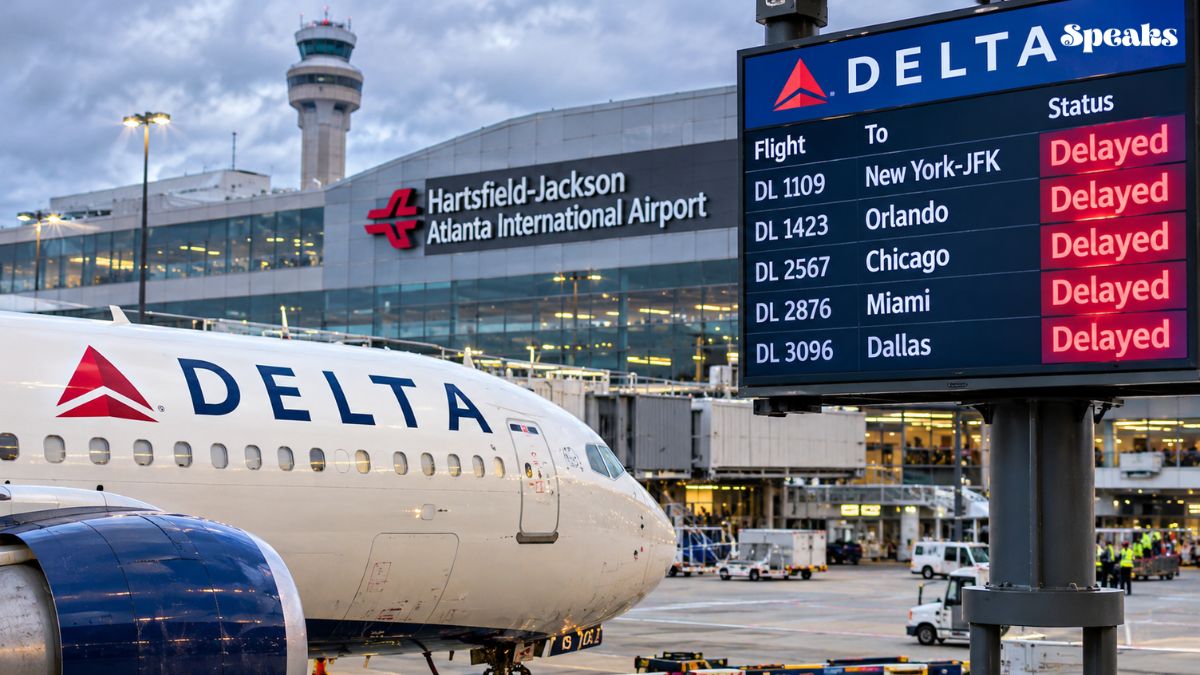
Thousands of travelers faced disruptions at Hartsfield-Jackson Atlanta International Airport on Sunday, November 22, after operational problems triggered a ground stop affecting Delta Air Lines flights arriving at the airport.
The Federal Aviation Administration (FAA) initially issued a ground stop for Delta flights heading to Atlanta. The restriction was introduced Sunday morning following a request from the airline as teams worked to address an operational issue affecting flight departures.
According to the FAA’s advisory, the disruption was expected to result in more than 3,500 flight delays. The agency later downgraded the ground stop to a ground delay shortly after 8:40 a.m. Eastern Time.
Although the change allowed operations to move forward under a different restriction, passengers continued to face significant delays. The FAA reported that average delay times were running just under one hour, with the advisory estimating that the disruption could continue until approximately 1 p.m.
The situation was classified as a carrier-specific disruption rather than an airport-wide restriction affecting every airline. The FAA also assigned a medium probability to the possibility of extending the ground stop.
Delta Air Lines said the operational problem involved automation used to calculate aircraft weight and balance for departing flights. These calculations are essential for determining safe operating conditions before an aircraft leaves the airport.
In a statement provided to local media, the airline confirmed that its teams were working to restore the automated system while using manual procedures to keep departures moving safely.
Delta said its employees were relying on manual workarounds to complete the necessary departure calculations. The airline also thanked passengers for their patience and acknowledged the efforts of employees managing the disruption.
The technical issue created additional pressure at Atlanta, which serves as Delta’s primary hub. Large numbers of arriving and departing aircraft move through the airport every day, making operational coordination particularly important during periods of disruption.
Delta also said it was coordinating with Air Traffic Control to manage traffic strategically. The airline’s immediate priority was to prevent congestion around airport gates and on taxiways while departures continued under the manual procedures.
For passengers, the disruption meant potential changes to departure schedules, connecting flights and arrival times. Travelers connecting through Atlanta could also experience delays if their incoming or onward flights were affected by the operational restrictions.
Passengers scheduled to travel on Sunday were advised to monitor their flight status through Delta’s official website or mobile app before heading to the airport. Checking for gate changes and revised departure times can help travelers respond to changing schedules.
The FAA’s decision to downgrade the restriction marked a change in the operational response, but it did not mean that normal flight schedules had immediately resumed. Delta’s efforts to restore its automated weight and balance calculations remained central to the recovery process.
The disruption comes as Delta works to manage flight operations at one of the busiest airports in the United States, with the airline using temporary manual procedures to maintain safety while technical teams address the underlying problem.