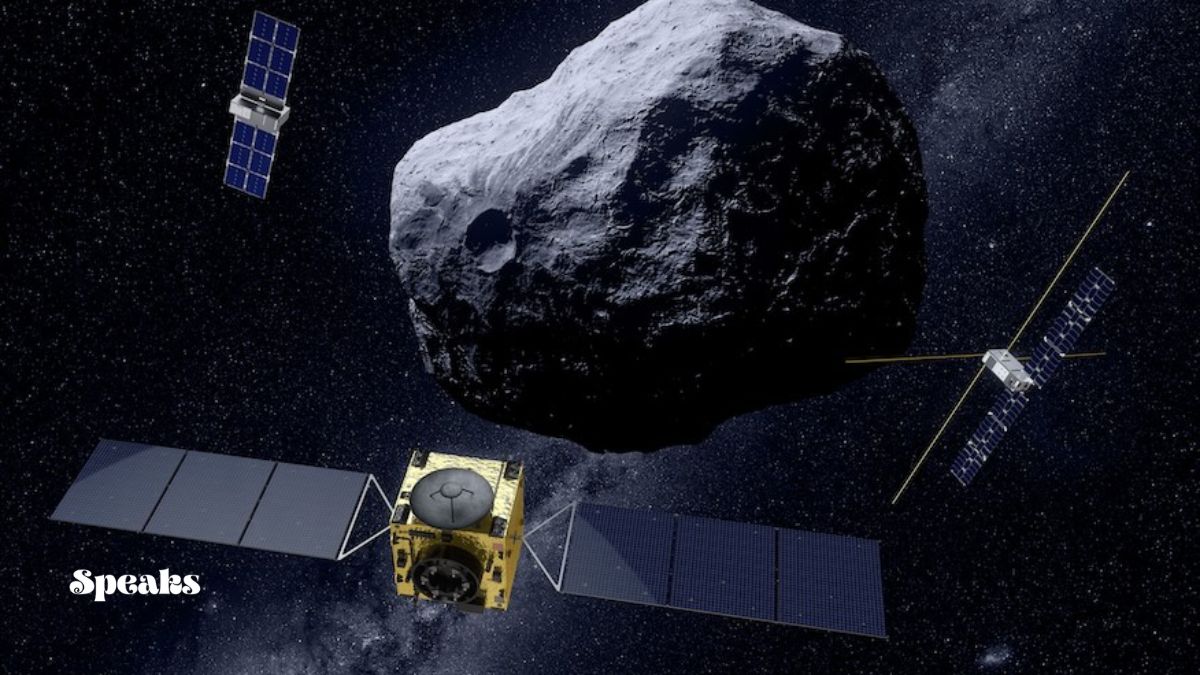
Europe’s Hera spacecraft has begun a close investigation of an asteroid deliberately struck by NASA, bringing scientists closer to understanding how humanity could protect Earth from future space threats.
The European Space Agency (ESA) mission is examining the Didymos asteroid system, including Dimorphos, the smaller space rock whose orbit NASA successfully changed in 2022.
The investigation will help scientists understand the effects of the collision and improve future asteroid deflection strategies.
Hera Spacecraft Reaches NASA’s Asteroid Impact Target
The Hera spacecraft has reached the Didymos asteroid system and started its early scientific observations from approximately 25 to 30 kilometers away.
Its main target is Dimorphos, a moonlet measuring approximately 151 meters across that orbits the larger asteroid Didymos.
Hera will examine the surface, structure, mass and physical properties of both objects, focusing particularly on the area affected by NASA’s earlier collision experiment.
How NASA’s DART Mission Changed an Asteroid’s Orbit
NASA conducted its Double Asteroid Redirection Test (DART) on September 26, 2022, deliberately crashing a spacecraft into Dimorphos.
The impact changed the moonlet’s orbital period around Didymos by approximately 33 minutes, demonstrating that a spacecraft could alter an asteroid’s movement.
The collision also released a huge cloud of rocky debris that extended more than 10,000 kilometers into space.
Although the experiment demonstrated asteroid deflection, scientists still need detailed information about the collision site and Dimorphos’s internal structure.
What Will ESA’s Hera Mission Investigate?
Hera will use its scientific instruments to examine the asteroid system and determine how the DART collision changed its physical characteristics.
The spacecraft will investigate several important questions:
- Whether the impact created a crater or significantly reshaped Dimorphos
- How the collision affected the asteroid’s mass and internal structure
- What materials make up its surface
- How debris from the collision changed the surrounding environment
- How accurately scientists can predict future asteroid deflection experiments
These measurements will help researchers improve computer models used to assess planetary defense missions.
Two CubeSats Will Explore the Asteroid More Closely
The Hera spacecraft also carries two smaller satellites, named Milani and Juventas, designed to conduct additional investigations.
Milani will study the asteroid’s surface composition, while Juventas will use radar technology to investigate its internal structure.
Both CubeSats are designed to collect information that would be difficult to obtain using Hera alone.
Their measurements could provide important clues about the material beneath Dimorphos’s surface and how the asteroid responded to the DART collision.
Can the Hera Mission Help Protect Earth From Asteroids?
The mission represents an important step toward developing reliable planetary defense technology.
NASA’s DART experiment demonstrated that a spacecraft could change an asteroid’s orbit, but understanding the physical consequences remains essential for future missions.
Hera’s observations will help scientists determine which impact models accurately describe the collision and how much force might be needed to redirect another asteroid.
Neither Didymos nor Dimorphos poses a known threat to Earth. The mission is designed to improve preparedness for potential future asteroid hazards.
When Was the Hera Spacecraft Launched?
ESA launched Hera on October 7, 2024, aboard a SpaceX Falcon 9 rocket from Cape Canaveral, Florida.
The spacecraft completed a Mars flyby in March 2025 before continuing toward the Didymos asteroid system.
After its arrival in November 2026, Hera began its initial observations before moving closer for more detailed scientific investigations.
The mission is expected to provide scientists with a much clearer understanding of the first successful full-scale asteroid deflection experiment.