
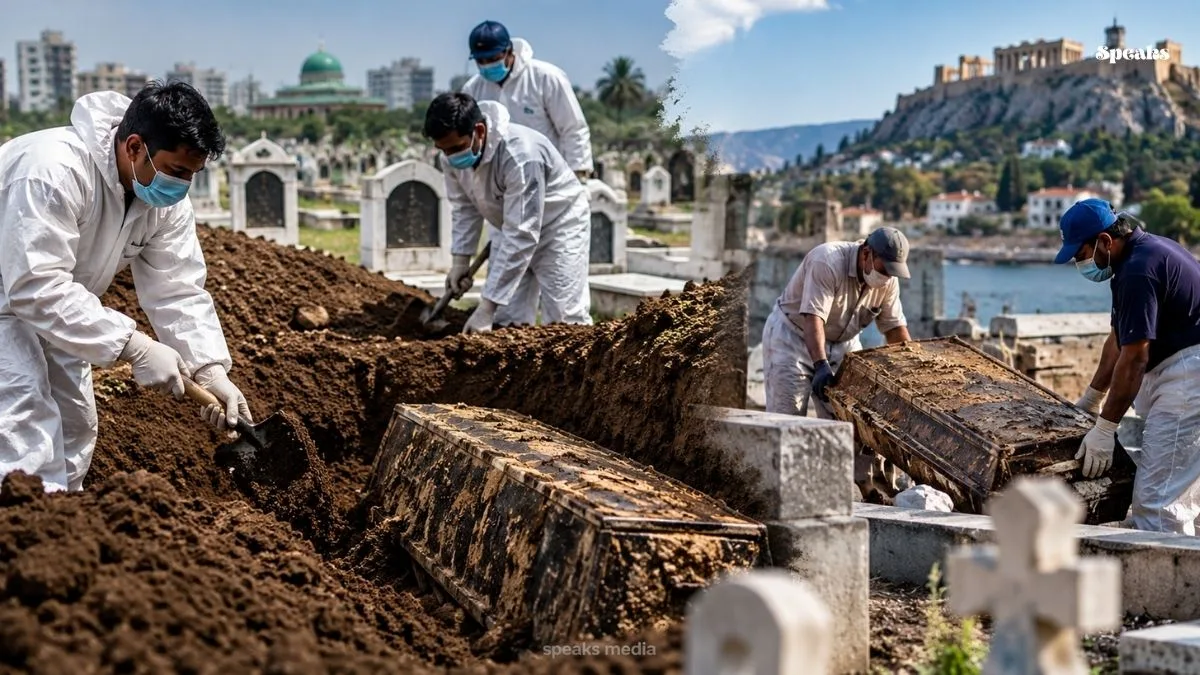
Burying a person in a grave after death is part of the final farewell in many cultures and religions of the world. It is generally believed that a grave is a place where a person finds eternal rest after burial. But in many countries of the world, due to the limited land of the cemetery, the same grave site is reused after some time.
This does not mean that every grave is opened after a certain time. Its rules vary by country, city, cemetery and local laws. In some places grave space is granted for a few years, while in others the right to use it is granted for a longer period. According to research available on some government cemeteries in Bangladesh, a typical grave fee may be for a period of two years.
Graves are reused
After this the same location can be used again. While for some reserved graves the period may be up to 15 or 25 years. In some cemeteries in Greece, the removal of remains after about three years is also part of the normal system. That is, the reopening of the grave is not only related to the complete decomposition of the body, but also to the lack of land and local order.
Strict rules vary from country to country
- Bangladesh: In some government cemeteries the general burial period may be two years. After this the space is reused. For some reserved graves the period may be 15 or 25 years.
- Greece: In some cemeteries, remains can be exhumed and placed in an ossuary about three years after burial.
- France: There are no uniform rules across the country. According to government information, different places may provide for 5-15 years, 30 years, 50 years or in some cases perpetual rights.
- Britain: Here too there is no single rule for opening graves after 20 years across the country. Different local organizations and cemeteries have different rules.
- America: Strict rules vary by state, local authority, and cemetery type. Therefore, it is not appropriate to give a fixed limit of 20 years for the whole of America.
What will happen in Bangladesh after two years?
An academic study on Bangladesh mentions the government cemetery system. According to this, the usual burial period in some places is two years. The same location can be reused after the expiry of the period. However, this does not mean that every grave should be dug as soon as the two years are over.
Reserve option for 15 or 25 years
For families who need a long-term burial space, some cemeteries may offer the option of a reserve period of up to 15 or 25 years. The main reason for this system is the scarcity of land in cities. With population growth, land for cemeteries is becoming limited. In such a situation, it may be difficult for many cities to permanently reserve a separate space for each person.
Why are remains exhumed after 3 years in Greece?
In some cemeteries in Greece it is common practice to exhume the remains after about three years. After this, the remains can be placed in a small bone box or ossuary, i.e. a place where bones are kept. In some cases, a fee is also charged for their maintenance.
The main reason for this arrangement is to make better use of the limited space of the cemetery. That is, instead of leaving the grave site empty for a long period of time, the same place can be used for the burial of another person after a specified period.
What are the rules in France and Britain?
In France, there is no uniform rule throughout the country regarding the period of burial. Different municipalities may have different time frames. In some places temporary concessions of 5 to 15 years, periods of 30 or 50 years and in some places even permanent rights can be obtained.
Even in Britain it is not fair to say that every grave is opened after 20 years. There, the right to use the grave, i.e. the permission to use the grave site, can be granted for different periods. In some places the period may be 20, 30, 40 or 50 years. Arrangements have also been made to reuse old graves in some areas where land is scarce.
Does the body die completely in 8 years?
It cannot be said with certainty that the body is completely destroyed in 8 years. A scientific study conducted by the Hanover Medical School in Germany studied cases of exhumation of bodies from 87 graves. Burial periods ranged from 5 days to 16.8 years.
The study found significant body decomposition after about 8 years, but in some cases, soft tissue remains were still found after 16.8 years. The speed of decomposition of a body depends on many factors such as soil, temperature, humidity, weather and burial conditions. So 8 years is not a fixed time limit.
Lack of land is not the only reason for reopening the tomb.
There can be many reasons for reopening a grave. The most common reasons include lack of space in the cemetery, local regulations, and expiration of the burial period. In some cases, the body may even be exhumed for legal examination. This should be considered different from normal grave reuse.
Therefore, the system of re-opening graves in different parts of the world cannot be viewed only from the point of view of religious tradition. In many places this is an administrative matter related to limited or permanent rights of use of grave space and availability of cemetery land.


