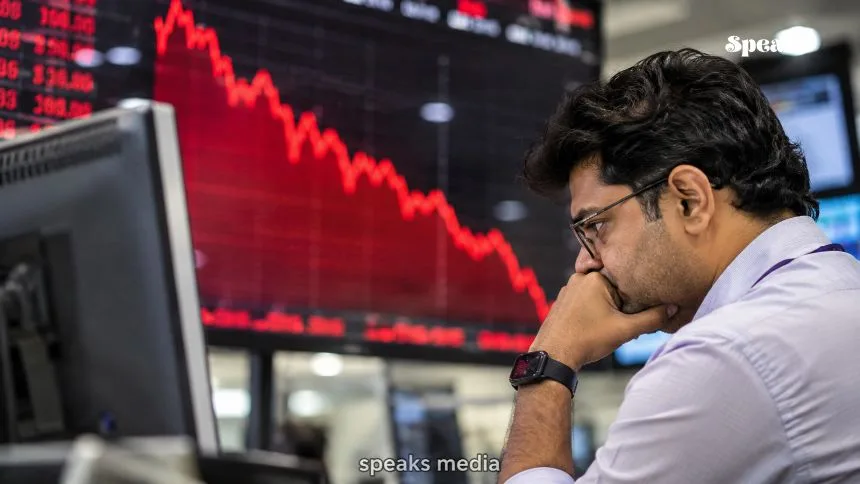
The artificial intelligence investment boom faced a major setback in October, with leading AI and semiconductor stocks losing approximately $5 trillion in combined market value since October 6. Despite the sharp decline, broader US markets have shown surprising resilience, raising questions about whether the latest selloff could create opportunities for investors.
According to Yahoo Finance calculations, some of Wall Street’s biggest technology companies suffered substantial losses during the month. Nvidia and Alphabet each lost approximately $835 billion in market capitalization, while Intel saw its market value fall by nearly half.
However, the weakness was not spread evenly across the market. The other 625 large US stocks included in the analysis collectively added around $1.3 trillion in market value over the same period.
AI Sector Stock Selloff in October Highlights a Growing Market Divide
The October decline has exposed a significant difference between investor sentiment toward major AI companies and the performance of the broader stock market.
While semiconductor and AI-related shares experienced heavy selling pressure, several other market sectors continued to advance. Nine of the S&P 500’s 11 sectors gained approximately 1% or more during the latest week, according to Yahoo Finance’s analysis.
This unusual market behavior suggests that investors may be moving money away from heavily valued technology stocks and exploring opportunities in other industries.
The S&P 500 also experienced a weekly decline, but the strength across most sectors indicates that the technology selloff has not necessarily developed into a wider market downturn.
Jeff Hirsch, editor of the Stock Trader’s Almanac, described the market’s tendency to react strongly to October declines as “Octoberphobia.” He told Yahoo Finance that he viewed the recent weakness as a potential buying opportunity, suggesting that the damage might be less severe than market headlines indicate.
Historical Stock Market Trends Point to a Potential Recovery
Historical market performance is providing another reason for investors to watch the coming months closely.
Data highlighted by the Stock Trader’s Almanac shows that the period following October in a US midterm election year has historically been favorable for stocks.
Since 1950, the S&P 500 has finished higher in all 19 recorded periods between the final trading day of October in a midterm election year and the end of the following June. The median gain across those periods was approximately 15%.
Semiconductor stocks have also shown a similar historical pattern. Since 1994, the sector has advanced in all eight comparable periods, recording a median gain of approximately 22%.
However, these historical results do not guarantee another rally. Semiconductor stocks experienced additional declines before recovering in some previous cycles, including 2002 and 2018.
The relatively small number of semiconductor observations also means investors should avoid treating seasonal trends as a reliable prediction of future performance.
Semiconductor Stocks Face Pressure After a 17% October Decline
The iShares Semiconductor ETF (SOXX), which tracks major semiconductor companies, dropped approximately 17% during October.
Despite that decline, the fund remained more than 50% higher for the year, highlighting how strong the earlier rally had been before the recent correction.
Friday’s trading session brought additional attention to an important technical level. SOXX briefly fell to approximately $460, moving below its July 29 low of $464.
However, the ETF recovered and finished the session at $472, moving back above that previous support level.
This type of price movement can sometimes indicate a potential bear trap, a situation in which prices briefly break below a support level before recovering and catching investors who had positioned themselves for further declines.
Jeff Hirsch sees the seasonal outlook as favorable for semiconductor stocks and indicated that his firm had initiated a new buying position in the sector.
For a stronger recovery, investors will be watching whether SOXX can move above approximately $524, followed by the early-October high near $596.
On the other hand, a sustained decline below the July low could increase the possibility of another major correction. The February-April trading range near $370 represents another downside reference point highlighted in the analysis.
Interest Rate Concerns Continue to Challenge AI Stocks
Not every Wall Street strategist believes the latest decline represents an immediate buying opportunity.
Michael Hartnett of Bank of America has maintained a cautious position, pointing to continued monetary policy uncertainty and rising interest rates across global markets.
Hartnett highlighted approximately 42 central bank rate hikes worldwide over the previous six months as a reason for investors to remain defensive.
Although the Federal Reserve kept interest rates unchanged at its latest meeting, two officials voted in favor of a rate increase, reflecting differences in views about the direction of monetary policy.
Hartnett is also monitoring the VanEck Semiconductor ETF (SMH), identifying approximately $520 as an important level for the fund.
SMH finished Friday’s session near $522, leaving it close to that threshold. The corresponding level for SOXX is approximately $469, just above the July support level that the ETF recently recovered.
These closely watched price levels could help investors assess whether semiconductor stocks are beginning to stabilize or remain vulnerable to further selling.
November Midterm Elections Could Shape Wall Street’s Next Move
Investors are also preparing for the US midterm elections scheduled for Tuesday, November 3, 2026. Political developments, economic expectations and Federal Reserve policy could all influence market sentiment during the coming weeks.
November has historically been one of the strongest months for the S&P 500, adding another seasonal factor to the current market outlook.
However, the latest AI stock correction has created a more complicated picture for investors. While major technology companies are facing significant valuation pressure, the strength in other sectors suggests that market participation remains broader than the headline losses might indicate.
The coming trading sessions will be important for determining whether semiconductor stocks can maintain their recent recovery levels and whether the wider market can continue to withstand pressure from the technology sector.