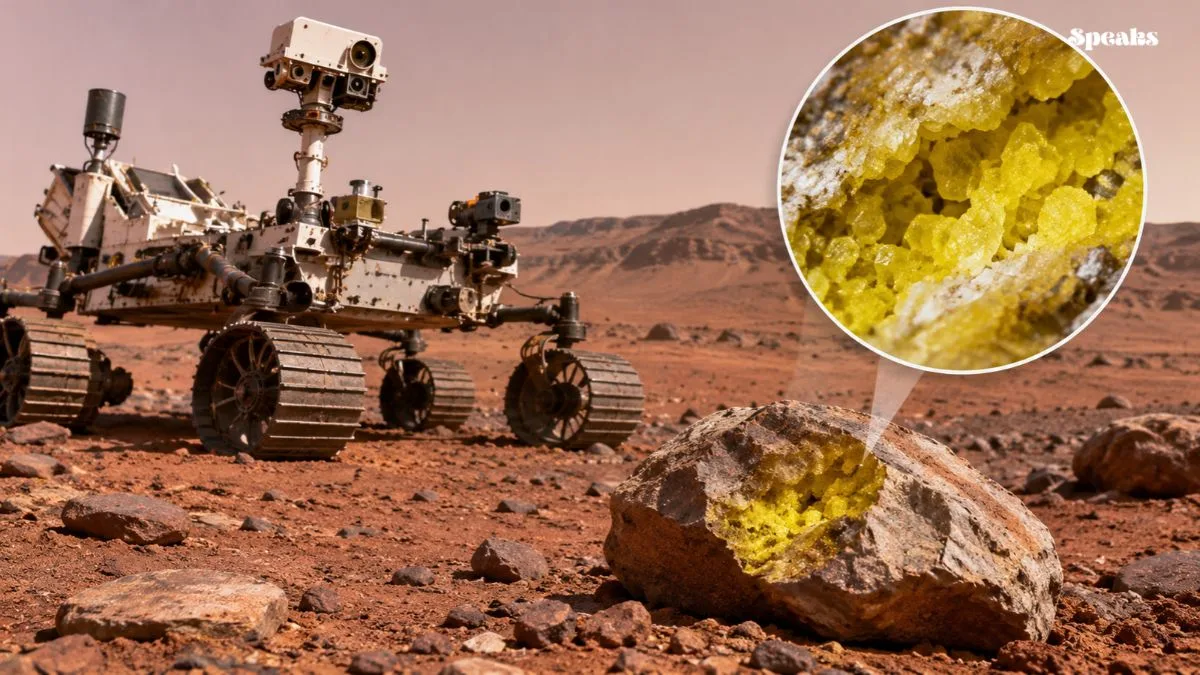
NASA’s Curiosity Mars rover uncovered an unusual geological surprise in Gediz Vallis after one of its wheels accidentally cracked open a rock, revealing bright yellow crystals hidden beneath the surface.
The discovery, made on May 30, 2024, gave scientists their first confirmed detection of elemental sulfur in its pure form on Mars. The finding raised new questions about the geological history of the Red Planet.
The rock was part of a wider field of pale-colored stones that Curiosity encountered while exploring the channel on the lower slopes of Mount Sharp. Scientists had not expected to find pure sulfur in this location.
What NASA Curiosity Found in Gediz Vallis
The discovery happened by chance. As Curiosity traveled across the rocky Martian terrain, its wheels rolled over a small rock and broke it apart.
The exposed interior contained bright yellow crystals. Images sent back to Earth showed a striking contrast between the pale outer rock and the yellow material inside.
Scientists used instruments aboard the rover to investigate the fragments. The Alpha Particle X-ray Spectrometer, mounted on Curiosity’s robotic arm, identified the crystalline material as elemental sulfur.
The rock was nicknamed “Convict Lake,” after a location in California’s Sierra Nevada. NASA later released close-up images showing the crystals in greater detail.
This was different from earlier sulfur-related discoveries on Mars. Previous observations had identified sulfates, which are sulfur-containing salts, but the newly exposed material consisted of elemental sulfur.
Why Pure Sulfur on Mars Surprised Scientists
Sulfur is not entirely new to Mars. Scientists have found sulfur-bearing minerals in several locations, including areas where ancient water may have evaporated and left mineral deposits behind.
However, finding concentrated deposits of pure elemental sulfur was unexpected. On Earth, this form of sulfur is associated with particular geological environments, including volcanic regions and hydrothermal systems.
NASA scientists have not yet identified the process responsible for producing the sulfur stones at Gediz Vallis. The surrounding landscape does not provide clear evidence for the volcanic or hot-spring conditions commonly associated with elemental sulfur on Earth.
That uncertainty makes the discovery especially valuable. Researchers now have a geological puzzle that could reveal more about the chemical and environmental history of Mars.
How Gediz Vallis Channel Formed on Mars
Gediz Vallis is a channel that cuts through part of Mount Sharp, a mountain rising about three miles (five kilometers) above the floor of Gale Crater.
Curiosity has been climbing the mountain since 2014, studying layers of rock that preserve evidence of different periods in Martian history. Each layer helps scientists reconstruct how the planet’s surface changed over time.
Researchers believe Gediz Vallis was shaped by powerful flows of water and debris. These events may have transported rocks and sediment down the mountain, creating piles of material along the channel.
Some stones in the deposits are rounded, a shape that can develop when rocks are carried by flowing water. Other areas contain more angular rocks, suggesting that landslides or dry avalanches also contributed to the landscape.
The rover also identified pale halos around fractures in some rocks. These features resemble changes caused by groundwater moving through cracks and triggering chemical reactions.
Together, these observations suggest that water and other geological processes played important roles in shaping the region.
What the Sulfur Discovery Reveals About Ancient Water
The presence of sulfur-bearing minerals across this part of Mars provides important clues about the planet’s wetter past.
Sulfates can form when water containing dissolved minerals evaporates. Their presence helps researchers investigate where water once existed, how long it remained and what chemical conditions were present.
Elemental sulfur is a different form of the element. Unlike sulfate minerals, it is not chemically bonded to oxygen in the same way.
Scientists are still investigating whether the pure sulfur deposits are connected to the sulfate-rich environment around Gediz Vallis. The relationship between the two remains uncertain.
Understanding how the sulfur formed could help researchers identify the chemical conditions that existed in this region billions of years ago.
How NASA’s Curiosity Rover Investigated the Rock
Curiosity carries several scientific instruments designed to study the composition, structure and appearance of Martian rocks.
Its Alpha Particle X-ray Spectrometer, or APXS, analyzes the chemical elements in nearby materials. The rover’s robotic arm can position the instrument close to a rock surface to collect measurements.
The Mars Hand Lens Imager, known as MAHLI, captures detailed close-up images. Curiosity’s Mast Camera, or Mastcam, provides wider views of the landscape and helps scientists document geological features.
These instruments allowed the mission team to move beyond simply observing the yellow crystals. They could examine the material and confirm that it was elemental sulfur.
The accidental discovery also demonstrated the value of exploring a landscape directly. A rock that appeared ordinary from the outside revealed a composition that scientists had not previously confirmed on Mars.
Does the NASA Curiosity Gediz Vallis Discovery Mean There Could Be Life on Mars?
The discovery does not provide evidence that life exists or once existed on Mars. Elemental sulfur is a geological material, and its presence alone cannot establish biological activity.
However, sulfur is important in planetary science and biology because it participates in many chemical reactions. On Earth, sulfur compounds are used by some microorganisms as part of their metabolism.
For Mars researchers, identifying different forms of sulfur helps build a more complete picture of the planet’s chemical environment. It may also help scientists understand whether ancient Martian conditions could have supported microbial life.
The key question is not whether the yellow crystals prove life existed, but what their formation reveals about the environment in which they developed.
Curiosity’s Work After Leaving Gediz Vallis
Curiosity continued documenting the sulfur-rich landscape as it moved through Gediz Vallis. In October 2024, the rover captured additional images of the bright stones before leaving the channel.
NASA later published a panorama showing the region and the field where the pure sulfur discovery occurred. Scientists continued examining the observations to understand how the unusual deposits formed.
The rover’s exploration of Mount Sharp remains important because its rock layers preserve a long record of environmental change. By studying those layers, researchers can investigate how water, sediment and chemical processes shaped ancient Mars.