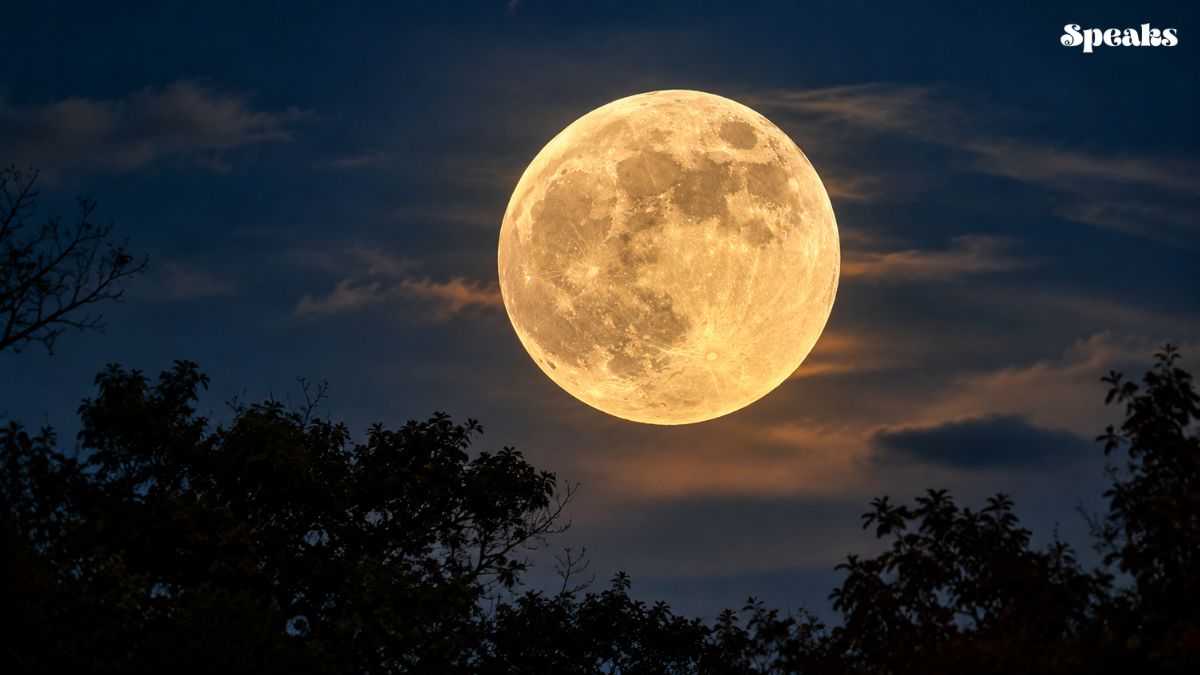
November’s Beaver Moon is bringing a spectacular celestial display this week, with the full moon becoming the first of three consecutive supermoons. Skywatchers across the United States, United Kingdom and Australia will have an opportunity to see the unusually bright lunar event.
The November full moon will reach peak illumination at 9:54 a.m. Eastern Time on Tuesday, November 24, according to astronomical calculations cited by CNN. Although the exact peak occurs during daylight hours in the United States, the moon will appear nearly full on Monday, Tuesday and Wednesday evenings.
The event is traditionally known as the Beaver Moon, a name associated with the time of year when beavers prepare their winter shelters and build dams before colder conditions arrive. The name also reflects the historical season when hunters set traps to collect beaver pelts.
This year’s event is particularly notable because it qualifies as a supermoon. The term describes a full moon that occurs when the moon is relatively close to Earth during its elliptical orbit, making it appear somewhat larger and brighter than an average full moon.
According to NASA planetary scientist Noah Petro, November’s supermoon will appear approximately 17% larger and 30% brighter than the smallest full moon of the year. People who regularly observe lunar events may notice the difference in its apparent size and brightness.
The moon’s orbit is not perfectly circular, meaning its distance from Earth changes throughout the month. When a full moon coincides with its closer orbital position, the lunar disk can appear more impressive to observers on Earth.
Kevin Lewis, a professor of Earth and planetary sciences at Johns Hopkins University, explained that the moon’s changing distance from Earth contributes to the visual difference associated with supermoons.
For the best viewing experience, astronomers recommend finding an open location with a clear view of the eastern horizon. Watching the moon rise shortly after sunset can create particularly striking views, especially when buildings, trees or mountains provide visual reference points.
The moon may also appear unusually large when it sits close to the horizon. This effect, known as the moon illusion, is an optical phenomenon in which the human brain perceives the lunar disk as larger when it appears alongside familiar objects.
The Beaver Moon does not require special equipment to enjoy. However, binoculars or a telescope can help observers examine lunar craters, surface features and the dark plains known as lunar maria, which formed through ancient volcanic activity.
November’s celestial event is also the beginning of a sequence of consecutive supermoons. The December Cold Moon and January’s Wolf Moon are expected to continue the series, offering additional opportunities for skywatchers to observe unusually close full moons.
The moon’s gravitational influence also affects Earth’s oceans. Full moons contribute to stronger tidal variations, although the actual effects depend on the moon’s position relative to Earth and the sun.