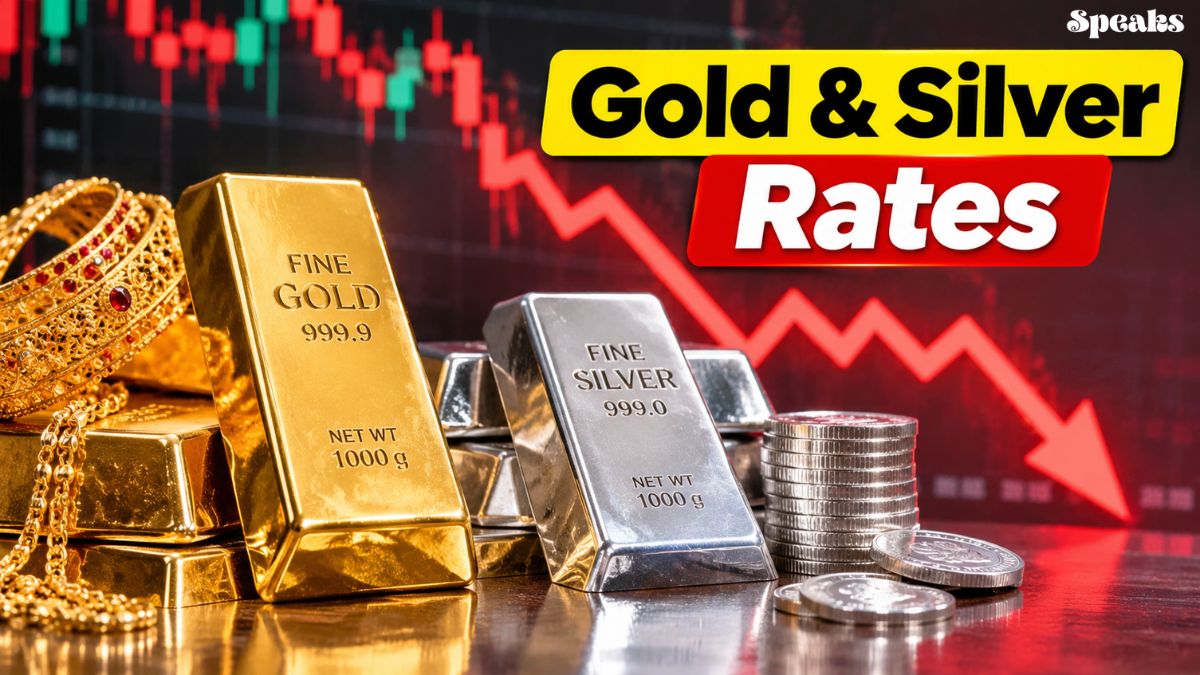
New York, NY: Gold and silver markets are facing one of their sharpest reversals of 2026, with a dramatic decline in precious metal prices wiping out an estimated $15 trillion in combined market value. The selloff has unsettled investors who previously viewed bullion as protection against economic uncertainty.
Gold ended the week of November 16 near $3,544 per ounce, approximately 37% below its January 29 peak of nearly $5,600. Silver suffered an even steeper correction, falling below $42 per ounce after reaching more than $122 earlier this year.
The scale of the decline has brought renewed attention to gold rates today and silver rates today, particularly as investors reassess their exposure to commodities ahead of the Federal Reserve’s December policy meeting.
According to estimates cited by CEOWORLD Magazine, the combined decline represents approximately $15 trillion in lost notional market value. However, this figure does not represent actual cash withdrawn from the market, since much of the world’s existing gold and silver is not actively traded.
Gold Rates Today
Gold has experienced a significant reversal after reaching record territory earlier in 2026. The metal’s decline accelerated during the third week of November, when prices recorded their largest weekly loss since March.
On November 20, gold briefly moved toward the $3,500 level, marking its weakest price in more than a year. The latest selling pressure has raised concerns about whether the market can regain momentum before the end of December.
The Federal Reserve’s monetary policy outlook is playing a major role in the decline. Higher interest rates increase the attractiveness of interest-bearing investments, making gold less competitive because physical bullion does not generate regular income.
The US dollar has also strengthened, with its index approaching 103.8, its highest level since April 2025. A stronger dollar generally makes dollar-priced gold more expensive for international buyers, potentially reducing demand.
For investors tracking gold rates today, the combination of higher borrowing costs, currency movements and portfolio liquidation has become particularly important.
Silver Rates Today
Silver has experienced an even more severe decline than gold, reflecting its dual role as both an investment asset and an industrial commodity.
Prices dropped below $42 per ounce on November 20, compared with a January high above $122. That represents a decline of approximately 65%, placing silver among the hardest-hit major precious metals during the latest market correction.
Unlike gold, silver prices are closely connected to industrial demand. Manufacturing, electronics, solar energy and other industrial applications contribute to its long-term demand outlook.
Concerns about global economic growth and technology-sector investment have therefore added another layer of pressure to the silver market.
The latest movement in silver rates today also highlights how quickly investor sentiment can change when financial markets experience widespread selling.
Why Gold and Silver Are Falling Despite Global Market Uncertainty
Precious metals traditionally attract investors during periods of geopolitical uncertainty and financial instability. However, the November selloff has challenged that familiar relationship.
Investors have been reducing exposure to several asset classes, including technology stocks, cryptocurrencies and commodities. Some market participants have reportedly sold precious metals to raise cash and cover losses elsewhere in their portfolios.
Financial market analyst Kyle Rodda of Capital.com described the situation as involving forced liquidation across markets.
This suggests that the latest decline is not simply a reaction to weaker demand for gold and silver. Liquidity pressures are also influencing trading decisions, particularly among investors facing losses or margin requirements.
When investors need immediate cash, highly liquid assets such as gold can become among the first holdings they sell.
Federal Reserve Interest Rate Decision Adds Pressure to Precious Metals
The Federal Reserve’s next policy decision is emerging as a major factor for precious metal investors.
The central bank raised its benchmark interest rate by 0.25 percentage points on September 16, taking the target range to 3.75%–4.00%. It subsequently held rates steady at its October 28 meeting.
Meanwhile, US consumer prices increased by 0.4% in October, adding to concerns that inflation could remain difficult to control.
Market expectations have shifted toward another possible rate increase at the Federal Reserve’s December 8–9 meeting. Futures pricing indicated a probability above 90% for an increase by November 20, according to the CEOWORLD report.
A further increase could create additional pressure on gold and silver by making cash and government bonds more attractive relative to non-yielding precious metals.
Investors will also be watching Federal Reserve officials for indications of whether tighter monetary policy could continue into 2027.
Central Banks Continue Buying Gold Despite the Price Decline
The recent correction has not eliminated institutional interest in gold. Central banks continued purchasing substantial quantities of the metal during the third quarter of 2026.
According to World Gold Council data, central banks added 321 tonnes of gold during the quarter, representing a 42% increase compared with the same period last year.
Total purchases during the first nine months reached 675 tonnes, approximately 6% higher than the corresponding period in 2025.
China and Poland were among the leading reported buyers. However, central bank demand has not been strong enough to offset the selling pressure coming from financial investors.
The difference lies in the speed and scale of transactions. Central banks generally build reserves over extended periods, while exchange-traded funds and futures investors can adjust their positions much faster in response to interest rate expectations.
This explains why strong official gold purchases have not prevented prices from declining sharply.
Gold ETF Holdings Reach Record Levels Before November Selloff
Investment demand also remained relatively strong before the latest correction intensified.
Gold-backed exchange-traded funds attracted approximately $2.7 billion in October, marking their fourth consecutive month of inflows. Their combined holdings reached a record 4,275 tonnes.
Despite those inflows, assets under management declined by approximately 6% to $542 billion as falling prices reduced the overall value of investor holdings.
North American funds recorded outflows of approximately $512 million, while European and Asian investors continued adding exposure.
These figures suggest that investor sentiment has not moved uniformly across regions. Some investors are reducing positions, while others continue treating gold as a long-term portfolio asset.
What the Estimated $15 Trillion Precious Metals Loss Really Means
The $15 trillion figure requires an important distinction between a decline in estimated market value and actual financial losses.
The World Gold Council estimates that above-ground gold stocks reached 219,891 tonnes at the end of 2025. Based on that supply, the decline from approximately $5,600 to $3,550 per ounce translates into nearly $14.5 trillion in reduced notional value.
This calculation accounts for most of the estimated $15 trillion figure. The additional contribution from silver depends on the quantity of above-ground silver included in the calculation.
However, much of the world’s gold is held as jewelry or stored in central bank reserves. Approximately 44% of above-ground gold is jewelry, while around 18% is held by central banks.
These holdings are not regularly traded in financial markets. Therefore, the headline figure should not be interpreted as $15 trillion in cash losses experienced by investors.
The actual financial impact is concentrated among bullion holders, exchange-traded fund investors, futures traders and mining companies exposed to changing metal prices.
What Investors Will Watch in the Gold and Silver Markets Next
The coming weeks could be important for precious metals as investors assess monetary policy, currency movements and global demand.
The Federal Reserve’s December meeting will be a major event for traders. Any indication of additional interest rate increases could influence the direction of gold and silver prices.
Investors will also monitor the US dollar index, Treasury yields, gold ETF flows and central bank purchasing figures for signs of changing market sentiment.
For long-term investors, the latest correction has reopened questions about the role of precious metals in diversified portfolios. Gold may continue to serve as a reserve asset, but its ability to protect portfolios during sudden liquidity shortages is facing renewed scrutiny.