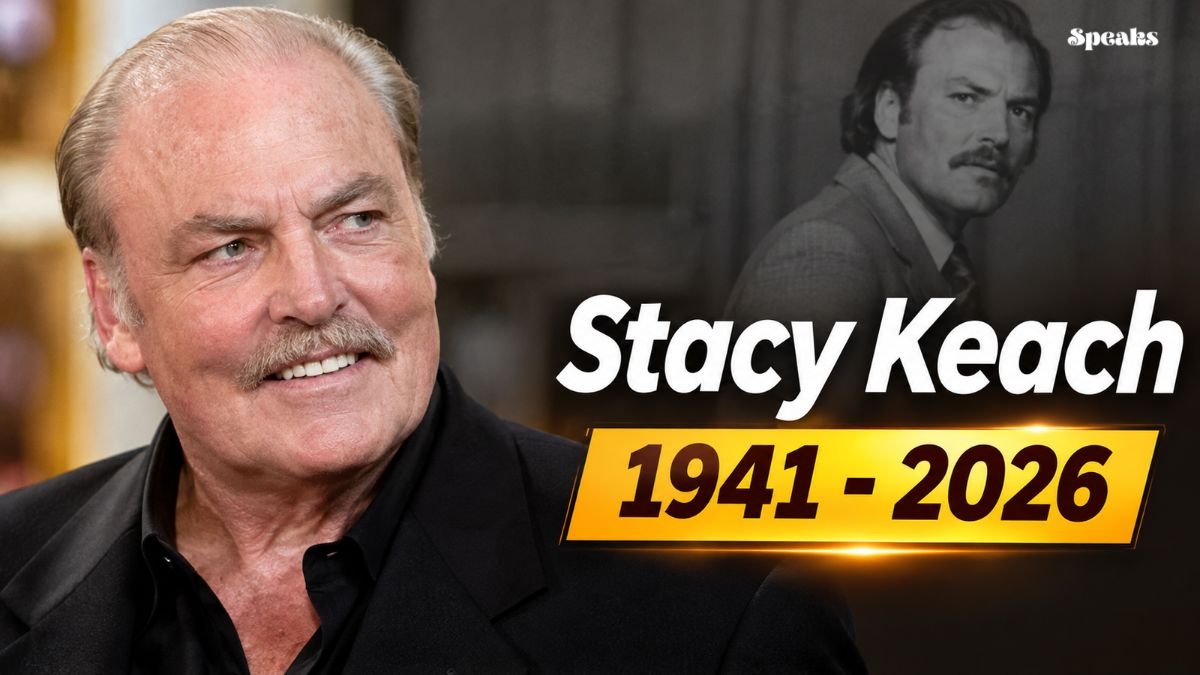
Stacy Keach, the acclaimed American actor celebrated for playing television detective Mike Hammer and delivering powerful performances across film, television and theater, has died at the age of 85.
Keach died on Tuesday, November 10, 2026, at his home in Magdalenka, Poland. His wife, Malgosia Tomassi Keach, confirmed his death, saying he had faced a prolonged battle with a serious heart condition and heart failure.
His death marks the loss of a performer whose career stretched across more than six decades. Although millions of television viewers recognized him as the tough private investigator Mike Hammer, Keach built a much broader legacy through Shakespearean theater, Hollywood films and acclaimed television productions.
Born on June 2, 1941, in Savannah, Georgia, Keach grew up in a family connected to the performing arts. His parents were both actors, giving him an early connection to the world of theater and entertainment.
He developed his acting skills through formal education, studying at the University of California, Berkeley, before attending the prestigious Yale School of Drama. He also studied at the London Academy of Music and Dramatic Art as a Fulbright scholar.
Keach’s early training helped establish his reputation as a serious stage performer. He became particularly respected for interpreting Shakespeare, taking on demanding roles in productions of Hamlet, Macbeth, Richard III and King Lear.
His breakthrough in television came through the character Mike Hammer, the fictional private detective created by crime novelist Mickey Spillane. Keach brought the hard-boiled investigator to life in television movies and series throughout the 1980s.
The role made him a familiar face among American television audiences. His portrayal combined a tough personality with a strong sense of justice, helping establish one of the most recognizable detective characters of that television era.
Keach appeared in Mickey Spillane’s Mike Hammer and later The New Mike Hammer. His performance became so closely associated with the character that he remained widely identified with the detective throughout his career.
His work was not limited to crime television. Keach also earned recognition for playing writer Ernest Hemingway in the 1988 television miniseries Hemingway, a performance that won him a Golden Globe Award and an Emmy nomination.
For the demanding role, Keach gained approximately 35 pounds to portray the legendary American author convincingly. His performance demonstrated the physical and emotional commitment that became a defining feature of his acting career.
On the big screen, Keach worked with acclaimed filmmaker John Huston in Fat City (1972) and The Life and Times of Judge Roy Bean (1972). He later appeared in films including The Long Riders, American History X, The Bourne Legacy and Nebraska.
His film career also included appearances in Up in Smoke, Roadgames, The Ninth Configuration and Children of the Corn. He consistently moved between different genres, taking on dramatic, comedic and character-driven roles.
A new generation of television viewers came to know Keach through his appearance in Prison Break, where he played Warden Henry Pope. His performance added depth to the popular Fox drama, which originally aired from 2005 to 2009.
He also became part of the cast of CBS police drama Blue Bloods, playing Archbishop Kevin Kearns in a recurring role. His character brought a different perspective to the show’s stories involving family, faith and law enforcement.
Another notable television credit was the sitcom Titus, in which Keach played Ken Titus, the central character’s outspoken father. The role showed his ability to move comfortably between serious drama and comedy.
Keach also appeared in Ray Donovan, The Simpsons, Two and a Half Men and Body Bags. His work across different formats demonstrated why he remained a respected character actor well into his later years.
His final film appearance came in Noah Baumbach’s 2025 movie Jay Kelly, starring George Clooney and Adam Sandler. Keach played Jay Kelly’s father, adding another memorable performance to an already extensive screen career.
Despite his success, Keach experienced a major personal and professional setback in 1984. He was arrested at London’s Heathrow Airport in a cocaine-smuggling case while working on the Mike Hammer television production.
He was subsequently sentenced to nine months in prison and served six months at Reading Prison in England. The incident temporarily interrupted his career and became one of the most difficult periods of his life.
Keach later spoke openly about his cocaine addiction and the consequences of substance abuse. Rather than avoiding the subject, he used his experience to encourage others to seek help and understand the dangers of addiction.
Following his release, he gradually rebuilt his career. His return to television included Intimate Strangers and a comeback as Mike Hammer, demonstrating that the setback had not ended his career.
His stage work remained equally important throughout his life. Keach received a Tony Award nomination for playing Buffalo Bill in the Broadway production of Indians.
He also portrayed former U.S. President Richard Nixon in the touring production of Frost/Nixon. His ability to take on historically significant figures further strengthened his reputation as a versatile performer.
In 2015, Keach was inducted into the American Theater Hall of Fame, recognizing his contribution to American stage productions. He also received a star on the Hollywood Walk of Fame in 2019.
His personal life included four marriages. He was married to Polish actress Malgosia Tomassi Keach, whom he met through the Mike Hammer television series.
Keach is survived by his wife, Malgosia, and his two children, Shannon and Karolina, along with his grandchildren. His family remembered him as a devoted husband and father whose influence extended beyond his professional achievements.
Actor Lou Diamond Phillips also paid tribute to Keach, describing him as a generous, kind and exceptionally talented performer. The tribute reflected the respect he earned from colleagues throughout his decades in the entertainment industry.