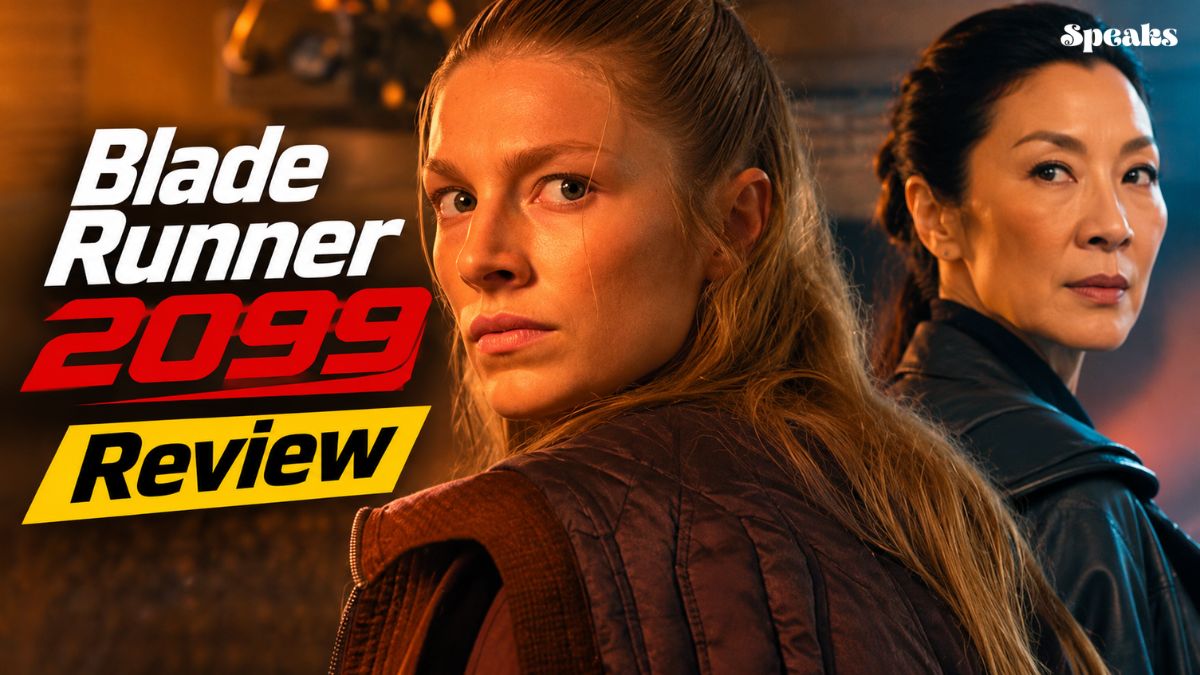
Amazon Prime Video is expanding one of science fiction’s most recognizable franchises with Blade Runner 2099, an eight-episode limited series that takes the story into a dramatically different future. Led by Hunter Schafer and Michelle Yeoh, the show revisits the franchise’s familiar questions about identity, artificial life and what makes someone human.
The new series moves beyond the familiar conflict between humans and Replicants. Instead, it imagines a society where the artificial beings have gained control and humans have become the population living under their authority.
The result is an ambitious television adaptation that combines a new power structure, investigative storytelling and a visually detailed dystopian setting. Schafer’s performance gives the production much of its emotional momentum.
Blade Runner 2099 Review
The original Blade Runner, directed by Ridley Scott and released in 1982, introduced audiences to a world where human-made Replicants were hunted by specialized officers. Denis Villeneuve’s Blade Runner 2049 continued that story through a Replicant protagonist searching for answers about identity and existence.
The new chapter changes the direction of that conflict. Set decades after the events of the previous film, Blade Runner 2099 presents a future in which Replicants have successfully challenged their former human masters.
The traditional role of a Blade Runner has also changed. Replicant officers now track humans who resist the new social order, creating a reversal that gives the franchise a different perspective on power and survival.
Created by Silka Luisa, known for Shining Girls, the series uses this changed society to examine whether artificial beings can develop the emotional connections that their creators originally denied them.
Hunter Schafer Delivers a Major Performance as Cora
Hunter Schafer takes on the central role of Cora, a human who hides her identity by pretending to be a Replicant. Her character enters the Blade Runner organization while pursuing an object that could potentially change the future of humanity.
The role demands more than physical action. Cora must maintain a convincing identity while dealing with fear, anger and the possibility that her real background could be discovered.
Schafer handles these conflicting emotions with considerable intensity. Early sequences give her opportunities to demonstrate both her physical commitment and her ability to communicate vulnerability without relying heavily on dialogue.
Her experience in HBO’s Euphoria and projects such as Cuckoo has helped establish her interest in genre storytelling. However, this series gives her a much larger opportunity to lead an ambitious science fiction production.
Cora’s complicated relationship with the Replicants also gives Schafer an interesting emotional challenge. She must portray someone who is capable of understanding her enemies while carrying personal reasons to distrust them.
Michelle Yeoh Adds Authority as Replicant Blade Runner Olwen
Michelle Yeoh plays Olwen, an experienced Replicant Blade Runner approaching the end of her programmed lifespan.
Unlike a conventional detective character, Olwen must confront the reality that her own existence is limited. Even though Replicants have gained control of society, they remain subject to the biological restrictions imposed by their creators.
Her partnership with Cora becomes an important part of the narrative. The two characters approach their work from different backgrounds, but their investigation gradually connects their individual struggles.
Yeoh brings a controlled screen presence to Olwen. Her experience in action-heavy productions also makes the character’s physical confrontations more convincing.
The contrast between Yeoh’s established action-star presence and Schafer’s emerging position as a leading genre performer gives the central pairing much of its appeal.
Their performances are among the strongest reasons to explore this new installment.
Futuristic Los Angeles Is One of the Series’ Biggest Attractions
The visual design plays a major role in establishing the identity of Blade Runner 2099. The production continues the franchise’s familiar cyberpunk atmosphere while introducing locations that expand its futuristic setting.
Cinematographers Rob Hardy, Ula Pontikos, Vanja Cernjul and Damian Garcia help create a distinctive visual environment through carefully composed lighting and atmospheric photography.
Instead of relying entirely on the traditional neon-lit cityscape, the series uses industrial surroundings, polluted beaches and unusual architectural spaces to establish its version of the future.
Production designers Paul Inglis and Chloe Arbiture contribute to several memorable environments, including a memory facility in Mexico, a red-lit business where Replicants simulate human experiences and a complex underground setting used during an action sequence.
These locations help make the world feel larger than the familiar streets of Los Angeles.
Costume designer Helen Huang also gives the main characters distinctive appearances. Olwen’s layered trench coat and Cora’s structured leather jacket reflect their personalities while maintaining the franchise’s established visual identity.
How Blade Runner 2099 Expands the Franchise’s Original Themes
The central question of the Blade Runner universe has always been connected to humanity. Its stories repeatedly challenge the assumption that biological humans automatically possess greater emotional depth than artificial beings.
The new series approaches that question through the idea of family and emotional attachment.
Replicants were originally designed without conventional family structures. Their creators believed that limiting emotional connections would prevent them from developing the motivations needed to challenge their position.
However, the new social order raises questions about whether those restrictions were ever enough to control artificial intelligence and human-like consciousness.
The series also revisits the Voight-Kampff test, the fictional method used to measure emotional responses and distinguish humans from Replicants.
Its presence connects the new story to the original films while allowing the creators to explore the meaning of empathy from a different perspective.
These ideas also carry relevance in a world increasingly shaped by artificial intelligence. As technology becomes more capable of imitating human behavior, questions about consciousness, emotional authenticity and responsibility remain important.
Silka Luisa Brings the Blade Runner Universe to Television
Silka Luisa leads the creative direction of the limited series, with Jonathan van Tulleken serving as producing director and directing its opening episodes.
Moving the franchise from feature films to an eight-episode television format creates opportunities to explore characters and locations in greater detail.
The longer format allows the story to follow multiple perspectives rather than concentrating entirely on one central investigation.
At the same time, expanding a film franchise into television brings a different storytelling challenge. The production must maintain the atmosphere and philosophical interests that made the earlier films distinctive while giving audiences enough narrative movement across multiple episodes.
Blade Runner 2099 approaches that challenge through its two central characters and their investigation into a mysterious artifact.
Is Blade Runner 2099 Worth Watching?
For viewers interested in science fiction, cyberpunk storytelling and character-driven mysteries, the series offers several reasons to pay attention.
Hunter Schafer and Michelle Yeoh provide a strong central pairing, while the production design creates a detailed environment that respects the visual history of the franchise.
However, viewers should approach the series as an expansion of the existing universe rather than expecting it to recreate the exact experience of the original films.
Its greatest strength is the opportunity to examine the Replicant world from a new perspective. The change in social hierarchy, combined with questions about mortality, family and artificial consciousness, gives the story its own identity.
The eight-episode format also gives the creative team more room to explore the characters and their motivations than a traditional feature-length sequel would allow.