
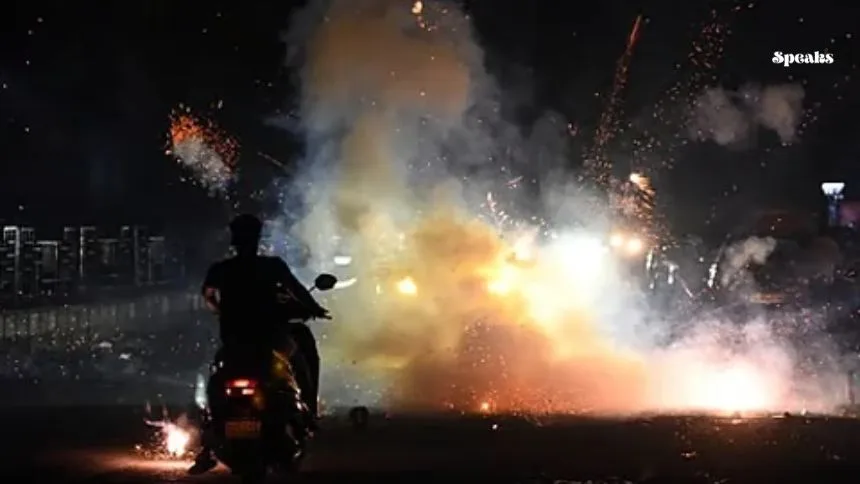
Pune’s air quality has deteriorated sharply following heavy firecracker use during Diwali celebrations, raising concerns about pollution levels across the city and its surrounding areas. The Air Quality Index (AQI) crossed 300 in several locations, while some suburban areas recorded readings above 500.
The deterioration was particularly noticeable after Lakshmi Puja on Sunday night, November 8, 2026. Fireworks continued across residential neighborhoods and central Pune, releasing large amounts of smoke and pollutants into the atmosphere.
According to air quality readings reported on Monday morning, November 9, Pune ranked 34th among the world’s most polluted cities. The city’s average AQI was reported above 200, with several monitoring locations recording significantly higher pollution levels.
The situation became particularly concerning in areas where firecracker celebrations continued well beyond midnight. Some locations reportedly recorded AQI readings exceeding 800 during the night, indicating extremely poor air conditions.
Before the celebrations intensified, Pune’s air quality was relatively normal. Readings between 8:30 PM and 9 PM on Sunday indicated comparatively better conditions, but the situation changed rapidly after widespread fireworks began following Lakshmi Puja.
Large firecracker chains, noisy explosives and decorative fireworks were used across different parts of the city. The resulting smoke spread through residential areas, contributing to a sharp increase in airborne pollutants.
Several neighborhoods experienced particularly high pollution levels on Monday morning. Wanowrie recorded an AQI of 517, while Kondhwa reached 417 and Katraj reported 360.
Other parts of Pune and the surrounding region also recorded elevated readings. Chinchwad registered 305, Shivajinagar 285, Warje 292 and Sahakarnagar 275.
The readings from other locations showed that pollution was not limited to a few neighborhoods. Sinhagad Road recorded 250, Viman Nagar 212, Nigdi 250, Tathawade 270 and Hinjawadi 260.
These figures highlight the uneven distribution of pollution across the Pune metropolitan area. Residents in areas with higher readings faced particularly poor outdoor air conditions following the festival celebrations.
The Air Quality Index is used to measure the level of air pollution and communicate its potential health effects. An AQI reading of up to 50 is generally considered good, while readings between 51 and 100 fall under the satisfactory category.
When the AQI reaches 101 to 200, air pollution can cause discomfort, particularly among children, older adults and people with respiratory conditions. Readings between 201 and 300 are classified as poor and can affect a wider section of the population.
An AQI above 300 falls into the very poor category under the commonly used Indian AQI classification. At these levels, prolonged exposure can increase the risk of respiratory problems and other health complications.
The sharp deterioration in Pune air quality also reflects the seasonal challenges faced by the city after the monsoon. Rainfall generally helps remove suspended dust particles from the atmosphere, temporarily improving air conditions.
However, once the rainy season ends, dust concentrations can increase. Construction activity, road dust, vehicle emissions and seasonal weather conditions can contribute to worsening pollution.
Diwali fireworks add another significant source of pollution during this period. Smoke and fine particles released by firecrackers can remain suspended in the air, particularly when weather conditions limit their dispersion.
The latest readings have renewed concerns about the impact of festival-related pollution on residents, especially children, senior citizens and people with asthma or other breathing difficulties.
Residents can reduce unnecessary exposure by limiting strenuous outdoor activities when pollution levels are high. Keeping windows closed during periods of heavy smoke and following official air quality advisories can also help reduce exposure.


