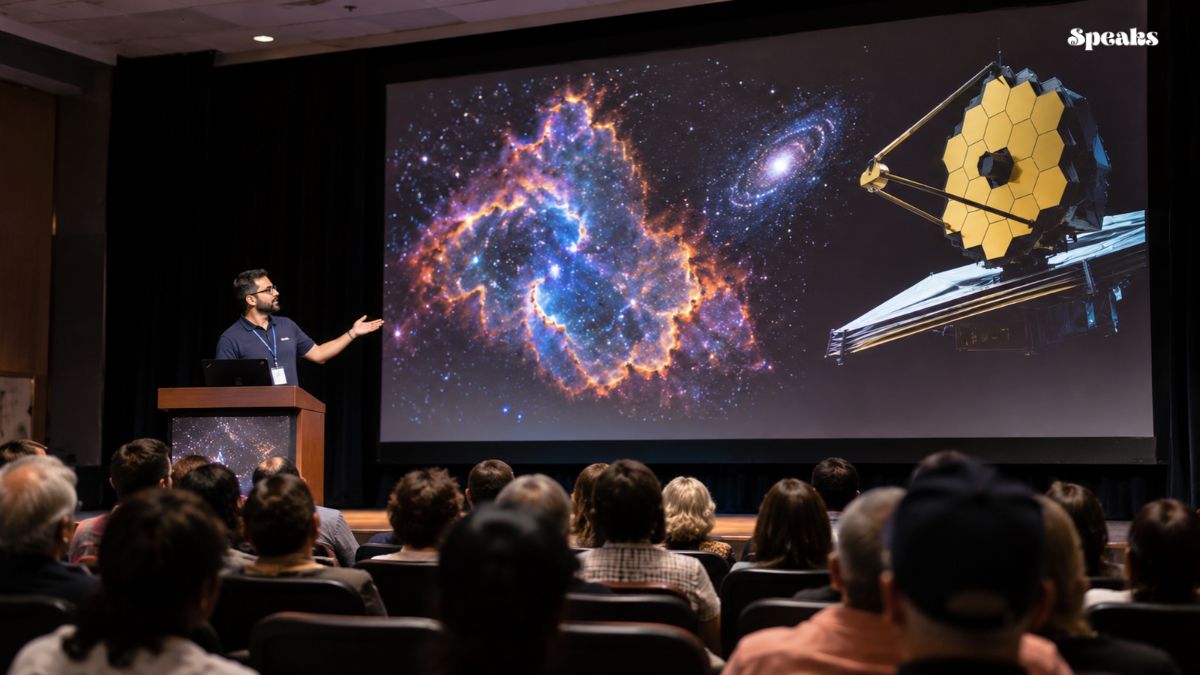
Astronomy enthusiasts in San Antonio will have an opportunity to explore some of the universe’s most remarkable images during a free public presentation on Friday, November 13, 2026. The event will focus on discoveries captured by NASA’s James Webb Space Telescope.
Organized by the San Antonio Astronomical Association, the monthly public meeting will feature an illustrated presentation titled “James Webb Space Telescope Images.” Astronomer Chris Packham will lead the discussion, highlighting some of the telescope’s most notable observations released since April 2025.
The presentation will take place from 7 p.m. to 8:30 p.m. at the Scobee Education Center and Planetarium, located at 1198 San Pedro Avenue in San Antonio, Texas. Admission is free, making the event accessible to members of the public interested in astronomy and space exploration.
The program will showcase a range of images captured by the James Webb Space Telescope, covering everything from Saturn’s icy rings to distant galaxies whose light has traveled billions of years before reaching Earth.
Packham will also discuss stellar nurseries, planet-forming disks, dying stars and galaxies influenced by interactions with other galaxies and supermassive black holes.
A key part of the presentation will explain how infrared observations help scientists study objects that are difficult to examine using conventional visible-light telescopes.
Webb’s infrared capabilities allow astronomers to investigate regions hidden by cosmic dust, observe the formation of stars and planets, and study extremely distant galaxies. These observations provide important clues about how the universe developed over billions of years.
The discussion will also explore how astronomers interpret the telescope’s colorful images. Although the images often feature striking colors, scientists use carefully processed data to represent different wavelengths of infrared light that human eyes cannot directly see.
Another topic will be gravitational lensing, a phenomenon in which the gravity of massive objects bends and magnifies light from more distant galaxies. This natural effect allows astronomers to examine objects that might otherwise be too faint or distant to observe.
The event will also look beyond current space telescope research by introducing the Habitable Worlds Observatory, a proposed future NASA mission designed to directly image potentially habitable planets orbiting other stars.
Scientists hope the observatory will eventually help examine the atmospheres of these planets and search for possible chemical signs of life. The project represents an important step toward understanding whether Earth-like environments exist elsewhere in the universe.
The San Antonio Astronomical Association regularly organizes public meetings and astronomy-related activities to encourage interest in space science. Its November gathering is designed particularly for amateur astronomy enthusiasts and people interested in learning how modern telescopes are changing our understanding of the cosmos.
The Scobee Education Center and Planetarium will host the presentation, with the event supported by the San Antonio Astronomical Association. Interested attendees can find additional information through the association’s official website at sanantonioastronomy.org.