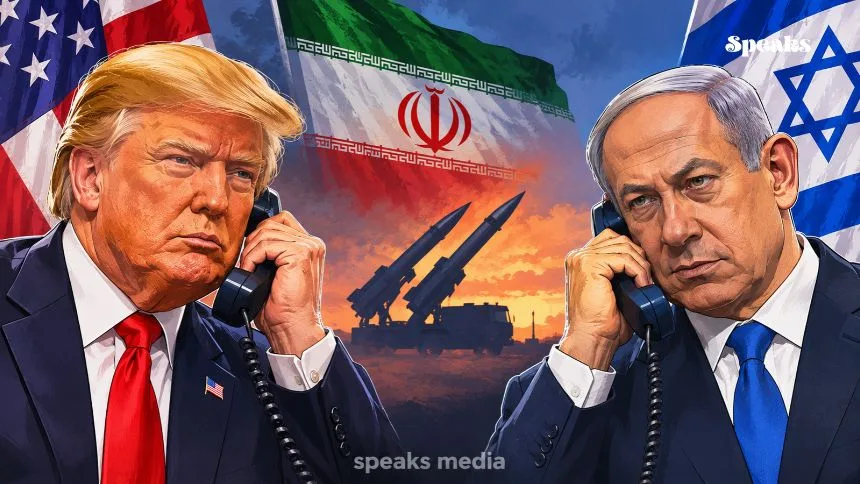
US President Donald Trump spoke by telephone with Israeli Prime Minister Benjamin Netanyahu on Saturday as Washington considered the possibility of renewed military action against Iran, according to a report by The Wall Street Journal.
The conversation comes amid rising tensions in the Middle East, with the Trump administration keeping military options open while diplomatic efforts to resolve the conflict with Tehran continue.
According to the report, the call followed a meeting at the White House earlier this week, where Trump consulted senior military officials about potential strategies for restarting major combat operations against Iran.
However, the US president has not made a final decision on whether to authorize additional strikes.
US Secretary of State Marco Rubio confirmed that diplomatic discussions involving Iran were still underway. Speaking to reporters after the G20 Foreign Ministers’ Meeting in Georgia, Rubio said communication between Washington and Tehran had continued through direct and indirect channels.
“There are multiple talks; talks have actually never stopped. There’s been active conversations going both in some cases directly, but often through intermediaries,” Rubio said.
Rubio declined to provide a deadline for negotiations or comment on how much progress had been made. He emphasized that the final decision on military action rests with Trump.
The secretary of state also said Washington remained open to a diplomatic agreement, provided it addressed American national security concerns, including Iran’s nuclear programme and its support for armed groups across the Middle East.
When asked whether the United States was prepared to resume military operations, Rubio said the administration believed it had the military capability to achieve its objectives if necessary.
“We can achieve military objectives if we seek to. He hasn’t made a decision,” Rubio said.
Meanwhile, Rubio accused Iran of threatening international maritime trade by targeting commercial vessels carrying oil, natural gas and other cargo. He said American naval forces had been intercepting drones and anti-ship missiles on an almost nightly basis.
He warned that continued disruptions to shipping routes could have wider economic consequences, particularly for global food security. Interruptions to fuel supplies, agricultural materials and food shipments could affect countries well beyond the Middle East.
Rubio also criticized Tehran’s relationship with regional armed groups, including Hezbollah in Lebanon, Yemen’s Houthi movement and several militias operating in Iraq. He described their activities as a threat to regional stability.
Despite the growing military concerns, diplomatic communication between the two countries has shown some signs of progress.
Iranian security official Mohsen Rezaei recently said the tone of a letter from US Vice President JD Vance represented a significant change in Washington’s approach.
“Their tone has shifted completely, which is a good sign that shows that our people have secured their victory,” Rezaei told Iranian state broadcaster IRIB.
The letter was reportedly delivered to Rezaei through Qatari mediators. According to reports by The New York Times and The Wall Street Journal, the communication outlined a framework for possible negotiations, with Iran’s nuclear programme expected to be among the central issues.
Iranian Foreign Minister Abbas Araghchi also confirmed that Tehran had reviewed the communication. He described Washington’s effort to reopen diplomatic discussions as a positive step and said an aide had travelled to Doha for consultations.
Al Jazeera reported that a potential meeting between representatives could take place within a week, with Doha and Istanbul being considered as possible locations. However, no formal meeting agreement had been announced.
Iran’s Supreme Leader Mojtaba Khamenei, meanwhile, warned that the country’s armed forces would respond to any further military or terrorist attacks by the United States or Israel. His remarks underscored the risk of another escalation if diplomatic efforts fail.
Trump had also addressed the possibility of negotiations during remarks at the White House on Friday. He claimed that Tehran wanted to continue discussions and suggested there was still time to reach an agreement.
“There are talks, they want to talk, they keep talking,” Trump said.
The latest Trump-Netanyahu conversation highlights the difficult position facing Washington as it considers renewed military action while maintaining diplomatic channels with Tehran. Neither the White House nor the US State Department has announced a confirmed timeline for any further military decision.