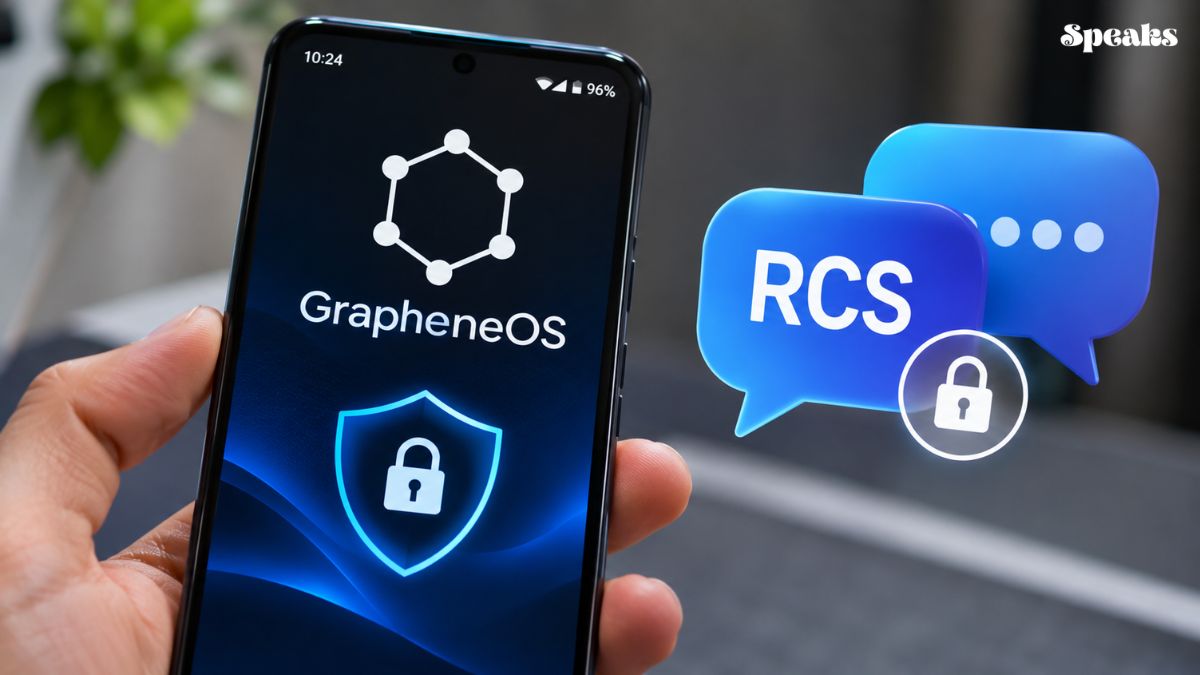
GrapheneOS has demonstrated a new messaging prototype that supports end-to-end encrypted Rich Communication Services (RCS) without relying on Google Messages. The development could give users greater control over their messaging experience while strengthening privacy on supported Android devices.
The open-source Android operating system is working to bring the feature directly into its built-in Messaging app. The prototype demonstrates how users could exchange encrypted messages without installing Google’s messaging application.
The demonstration was conducted on a Google Pixel 7 Pro and Pixel 9, both running GrapheneOS. The devices successfully exchanged text messages, reactions and images, while also displaying typing indicators and delivery and read receipts.
The technology behind the prototype is Messaging Layer Security (MLS), the encryption protocol included in the GSMA’s RCS specification. It is designed to protect conversations, including shared photos and other files, through end-to-end encryption.
An important aspect of the demonstration is compatibility. GrapheneOS says its implementation can support encrypted conversations with users running compatible versions of Google Messages and Apple’s Messages app.
The prototype also demonstrated that conversations did not automatically switch to unencrypted RCS during the test. This is significant for users who want messaging features without sacrificing encryption.
However, the initial implementation will still depend on sandboxed Google Play services for carrier registration. Many mobile carriers rely on Google’s infrastructure to verify phone numbers and activate RCS messaging.
GrapheneOS explained that its messaging application will need to communicate with Google Play services even after activation. Removing those services would therefore prevent RCS from continuing to work in the initial version.
The development team eventually wants to support carriers that provide RCS services independently of Google. This could allow some users to access RCS without installing Google Play services, although relatively few carriers currently offer that option.
GrapheneOS is also considering notification support through Google’s Firebase Cloud Messaging (FCM), alongside developing its own notification delivery system. UnifiedPush is among the possible alternatives being considered.
Another important challenge is integrating RCS with traditional SMS and MMS messaging. The completed application will need to switch to these older messaging standards when a recipient cannot receive RCS messages.
However, SMS and MMS conversations will not receive the same end-to-end encryption protection. GrapheneOS plans to improve its in-app warnings so users can identify when encryption is available.
The team also recommends using a dedicated secure messaging application for particularly sensitive conversations rather than relying entirely on RCS encryption.
For GrapheneOS users, the proposed change could reduce dependence on Google Messages while retaining compatibility with supported mobile networks. However, the first release will not completely eliminate Google’s involvement.
GrapheneOS has not announced an official release date for the integrated RCS feature. System-level development and SMS/MMS integration remain necessary before the prototype can become part of its standard Messaging application.