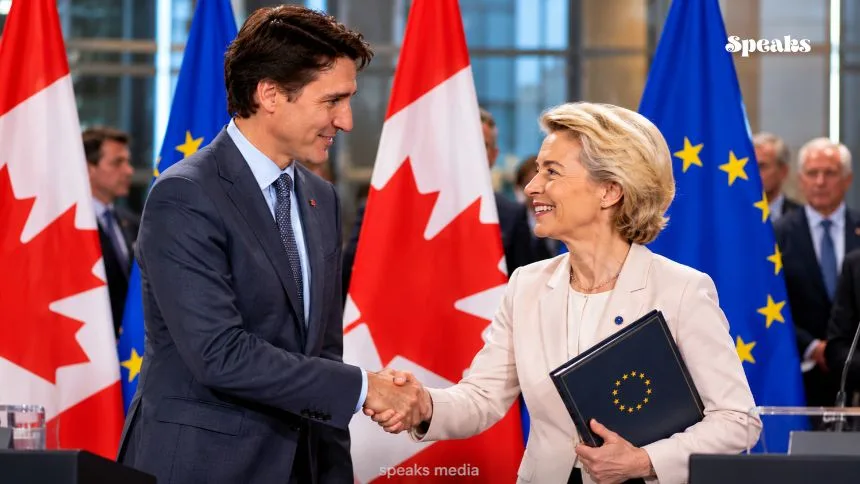
Canada is taking steps to reduce its economic dependence on the United States by strengthening trade and investment ties with the European Union, as an escalating trade dispute puts pressure on one of the world’s closest economic partnerships.
Prime Minister Mark Carney is pushing for a deeper relationship with Europe, including a proposed associate membership arrangement that could give Canada closer access to the EU’s economic and strategic networks.
The move comes as tariffs and trade restrictions create uncertainty for Canadian businesses that have traditionally relied heavily on the US market. News Channel 3-12+1
Canada-US Trade Declines as Tariff Dispute Deepens
For decades, Canada and the United States maintained closely connected economies, supported by cross-border supply chains in automobiles, energy, manufacturing and agriculture.
However, trade between the two countries has weakened since 2022. Tariffs introduced by US President Donald Trump and Canada’s retaliatory measures have added further pressure to the relationship.
In 2025, bilateral merchandise trade declined, with Canadian exports to the US falling 5.3% to $564.6 billion. The United States still accounted for 71.7% of Canada’s merchandise exports, but that share was lower than in previous years. ABC17NEWS+2
Canada Economic Ties With European Union Gain Momentum
Europe is becoming an increasingly important destination for Canadian businesses seeking alternatives to the US market.
According to Global Affairs Canada, merchandise trade between Canada and the European Union has increased by more than 78% since the implementation of the Comprehensive Economic and Trade Agreement (CETA). Trade in services has also grown by nearly 90%.
Two-way trade in goods and services reached approximately $178 billion in 2025, making the EU Canada’s second-largest trading partner. Canadian merchandise exports to the bloc increased by almost 21% between January and August 2026. Canada+1
The Canada economic ties European Union strategy also focuses on sectors beyond traditional merchandise trade. Both sides are exploring opportunities in critical minerals, clean technology, artificial intelligence, digital services and defense manufacturing.
What Canada’s Proposed EU Associate Membership Means
European Commission President Ursula von der Leyen proposed making Canada the European Union’s first associate member in September. The idea gained further momentum during the Canada-EU summit held in Montreal on October 29 and 30.
Carney has supported the proposal, describing the relationship as a way to strengthen Canada’s economic security and protect its ability to make independent decisions.
The proposed arrangement would not make Canada a full EU member or give it the same status as the bloc’s 27 member countries. Instead, it could establish a closer framework for cooperation in selected economic and strategic areas.
However, the proposal has faced resistance from some European governments, including Germany, which has expressed reservations about using the associate membership designation. European Commission+2
Canada and EU Focus on Critical Minerals, Defense and Digital Trade
The proposed partnership could create opportunities in several industries that are becoming increasingly important to global supply chains.
Critical minerals are a major priority because European manufacturers need reliable supplies of materials used in electric vehicle batteries, renewable energy systems and advanced technologies.
Canada also wants to expand cooperation with European companies in defense production, energy security and clean technology. Both sides are working toward stronger digital trade arrangements to make cross-border business operations easier.
At the Montreal summit, European Council President António Costa said the two sides expected to announce a digital trade agreement, alongside expanded scientific research partnerships and university exchanges. AP News+1
US Trade War Is Affecting Travel and Investment
The economic impact of the Canada-US dispute extends beyond tariffs and merchandise exports. Travel spending and investment decisions are also changing as political tensions influence consumer and investor behavior.
Canadian visits to the United States fell to 29.1 million in 2025, the lowest level outside the pandemic period since records began in 1972. Canadian spending in the US also declined from $16.1 billion in 2024 to $13.4 billion in 2025.
Investment activity has shown another significant shift. Canadian investors purchased $78.1 billion Canadian dollars worth of US stocks during the first half of 2026 before selling a record $31 billion Canadian dollars in July, according to Statistics Canada data cited by CNN.
The developments highlight how the trade dispute is affecting economic relationships beyond traditional imports and exports. ABC17NEWS
Can Europe Replace the US as Canada’s Biggest Trading Partner?
Canada’s efforts to diversify its trade relationships do not mean that the United States will immediately lose its position as the country’s largest trading partner.
The two economies remain deeply connected through energy supplies, manufacturing, transportation and financial services. Replacing that level of integration would require substantial investment and long-term changes in business relationships.
Carney has set a goal of doubling Canada’s exports to non-US markets over the next decade. Strengthening relations with Europe is an important part of that strategy, alongside efforts to expand trade with other international partners. AP News+1