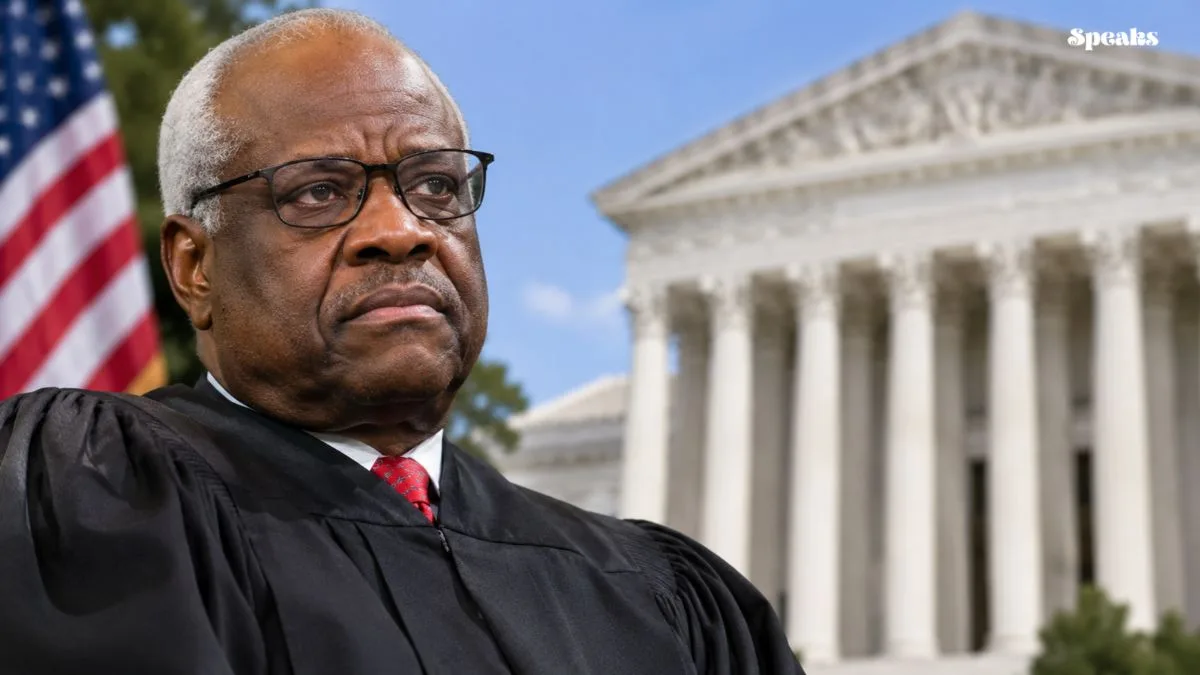
U.S. Supreme Court Justice Clarence Thomas has warned that a California law requiring medical educators to address implicit bias could weaken constitutional protections for private speakers. He raised the concern after the Supreme Court declined to review a challenge to the state’s requirement.
Thomas, joined by Justice Samuel Alito, dissented from the court’s November 16, 2026, decision not to hear the case. Their concern centers on whether state governments can require private individuals to communicate official viewpoints without facing First Amendment scrutiny.
The case, Khatibi v. Yip, involves a California physician who argued that the state’s continuing medical education rules force instructors to present a position on implicit bias that they do not personally support.
Why Clarence Thomas Issued a First Amendment Warning
The Clarence Thomas First Amendment warning focuses on a constitutional question: Can a government classify privately delivered speech as government speech simply because it heavily regulates the profession involved?
California requires licensed physicians to complete 50 hours of approved continuing medical education every two years. Since January 2022, those courses have also been required to include instruction about implicit bias.
The state says the training must cover examples of how implicit bias can influence physicians’ perceptions and treatment decisions, potentially contributing to differences in health outcomes. Courses may also discuss strategies for addressing those issues.
Thomas argued that the requirement goes beyond setting professional education standards. In his view, California is requiring private instructors to communicate a government-backed position on a subject they may disagree with.
He wrote that the First Amendment applies when the government requires private speakers to communicate its viewpoint rather than delivering its own message through government representatives.
What Is the California Implicit Bias Training Case?
The challenge was brought by Dr. Azadeh Khatibi, a California-licensed ophthalmologist, and the nonprofit organization Do No Harm.
Khatibi creates and teaches continuing medical education courses. She disagrees with the state’s position on implicit bias and argues that she should not be required to devote course time to presenting the subject in the manner California demands.
Do No Harm also challenged the requirement on behalf of members involved in medical education. The organization argued that the rule interferes with instructors’ ability to decide what they teach and how they express their views.
The legal dispute is not simply about whether implicit bias exists or whether medical professionals should study healthcare disparities. It concerns the government’s authority to require private educators to communicate a particular message.
California defended its authority to establish professional licensing and continuing education standards. The state also maintained that its regulatory role gives it broad control over the requirements physicians must meet to retain their licenses.
Why the Ninth Circuit Ruling Became a Supreme Court Issue
The case previously reached the U.S. Court of Appeals for the Ninth Circuit, which upheld the lower court’s decision.
The appeals court concluded that continuing medical education courses eligible for California board credit constituted government speech. It relied on the state’s extensive regulation of medical education and the professional licensing system.
That classification mattered because the court determined that the First Amendment did not apply to the challenged requirement in the way the plaintiffs had argued.
Thomas disagreed with that reasoning. He said the Ninth Circuit focused too heavily on the breadth of California’s regulatory system instead of examining who was actually speaking during privately organized courses.
He also questioned whether course participants would naturally understand an instructor’s presentation as an official statement from the state government.
Thomas Warns the Ruling Could Affect Other Professions
One of the most significant parts of Thomas’s dissent concerns the potential consequences beyond medical education.
He questioned whether the same legal reasoning could allow California to require speakers at legal education conferences to promote a particular position on racial preferences in law firm hiring.
He also raised hypothetical examples involving abortion and gender-transition procedures in medical education. These examples were intended to illustrate how the legal standard could potentially extend to other contested subjects.
Thomas argued that extensive government regulation of a profession should not automatically transform the private speech of its members into government speech.
His concern is that the distinction between government communication and private expression could become blurred if states can use professional licensing rules to determine what private instructors must say.
The Clarence Thomas First Amendment warning therefore reaches beyond one California medical education policy. It raises questions about the limits of government authority over speech in regulated professions.
What the First Amendment Says About Compelled Speech
The First Amendment protects freedom of speech and limits the government’s ability to interfere with private expression. Its protections are not limited to preventing officials from banning certain opinions.
The Supreme Court has also recognized that the government can violate free-speech protections by forcing individuals to express messages they do not support.
In West Virginia State Board of Education v. Barnette (1943), the court rejected a requirement that public school students salute the flag and recite the Pledge of Allegiance.
Another important case, Wooley v. Maynard (1977), involved a New Hampshire requirement that motorists display the state motto, “Live Free or Die,” on their license plates. The Supreme Court ruled that the state could not force an individual to display that message.
These precedents are relevant because the California dispute also involves whether the government can require private individuals to communicate a particular viewpoint.
Thomas believes the court should examine whether California is speaking for itself or regulating the expression of private instructors.
Supreme Court Declines to Hear the Case
On November 16, 2026, the Supreme Court denied the petition for a writ of certiorari in Khatibi v. Yip. That means the justices declined to review the lower court’s decision.
Thomas and Alito dissented from the denial, arguing that the case presented an important opportunity to clarify the government’s ability to compel private speech.
Justice Neil Gorsuch also indicated that he would have granted the petition. However, he did not join Thomas and Alito’s written dissent.
The decision not to hear the case leaves the Ninth Circuit’s ruling in place. It does not represent a Supreme Court ruling on the underlying merits of whether California’s requirement violates the First Amendment.
That distinction is important. The Supreme Court did not issue a nationwide judgment approving every aspect of California’s policy or resolve the constitutional questions raised by the challengers.
Thomas Questions the Supreme Court’s Government Speech Test
Thomas also used the case to question the legal framework established in Shurtleff v. Boston, a 2022 Supreme Court decision concerning government speech.
That framework considers the history of the expression, how the public would identify the speaker, and how much control the government exercises over the message.
Thomas argued that courts could place too much weight on government regulation when applying those factors. He suggested that the test may need reconsideration because it risks treating regulated private expression as government speech.
He warned that the government-speech doctrine should not become a way to avoid constitutional scrutiny when officials require private individuals to communicate an official viewpoint.
The dispute could remain relevant to future cases involving professional licensing, education requirements and government rules that affect what private speakers are allowed or required to say.