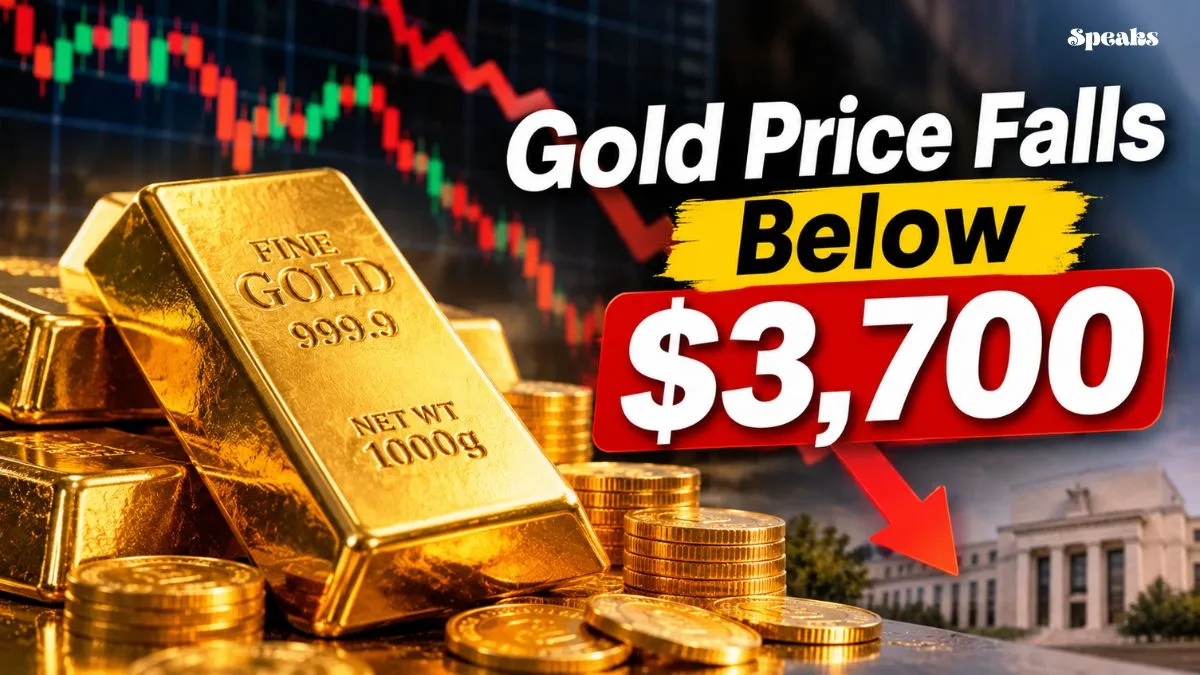
Gold futures extended their sharp decline on Thursday, November 19, falling below the closely watched $3,700 level as rising U.S. Treasury yields and persistent inflation concerns pushed investors away from non-yielding precious metals. Heavy selling pressure also reflected continued withdrawals from major gold-backed exchange-traded funds (ETFs).
December Comex gold futures settled at $3,627.30 per ounce, losing $100.50, or 2.70%, during the session. The contract had opened at $3,730.30 and briefly climbed to $3,759.50 before sellers took control, driving prices to an intraday low of $3,620.60.
The latest decline highlights how quickly sentiment has shifted in the precious metals market. Investors who previously viewed gold as an attractive store of value are increasingly weighing its appeal against higher returns available from U.S. government bonds.
Gold Price Under Pressure as U.S. Treasury Yields Stay Above 5%
Rising Treasury yields have emerged as one of the biggest challenges for gold. The benchmark 10-year U.S. Treasury yield moved above 5% following stronger-than-expected inflation data and has remained above that level in recent trading sessions.
Earlier in November, the 10-year yield had fallen to approximately 4.82%. However, renewed inflation concerns pushed it toward 5.17% last week, creating additional pressure on gold futures.
Higher bond yields generally make gold less attractive because bullion does not generate interest or dividend income. When government securities offer returns above 5%, investors may prefer holding bonds rather than allocating capital to an asset that depends entirely on price appreciation.
The relationship between Treasury yields and gold has become particularly important during the latest selloff. Gold futures have fallen more than 12% from their early-November levels, while the 10-year Treasury yield has increased by approximately 35 basis points.
Strong Treasury Returns Encourage Investors to Sell Gold ETFs
Institutional investment flows are adding another layer of pressure to the gold market. Recent withdrawals from major gold-backed ETFs suggest that some investors are reducing their exposure to bullion as higher interest rates change the relative attractiveness of different assets.
According to figures cited in the latest Kitco commentary, the SPDR Gold Trust (GLD) recorded more than $1.37 billion in outflows over the previous 30 days. The iShares Gold Trust (IAU) also experienced withdrawals of approximately $279 million during the same period.
These movements matter because large ETFs provide investors with a convenient way to gain exposure to gold without purchasing and storing physical bullion.
When investors withdraw money from these funds, the resulting changes in holdings can contribute to additional selling pressure in the underlying gold market.
The recent ETF activity also highlights a difference between short-term financial investors and institutions that hold gold for longer-term strategic reasons.
Central Bank Gold Buying Provides Longer-Term Support
Despite the latest market weakness, central banks continue to provide an important source of demand for physical gold.
According to the World Gold Council, central banks purchased approximately 321 tonnes of gold during the third quarter, representing a 42% increase compared with the same period a year earlier.
Central bank purchases are often driven by reserve diversification, geopolitical uncertainty and efforts to reduce dependence on individual currencies.
Unlike short-term investment funds, these institutions may have strategic reasons to hold gold regardless of movements in Treasury yields.
However, central bank demand has not been sufficient to offset the recent selling by financial investors. The World Gold Council also expects total central bank purchases in 2026 to remain below the 863 tonnes recorded in 2025.
Demand has not been uniform across countries either. Turkey, for example, has sold close to 60 tonnes of gold this year, highlighting differences in reserve-management strategies.
The contrast between continued institutional buying and declining ETF holdings remains an important factor shaping the precious metals outlook.
Gold Futures Face $3,500 as the Next Major Support Level
Market attention is increasingly shifting toward the $3,500 level as traders assess how much further gold prices could fall.
The December futures contract has already broken several important technical support areas, including summer price levels above $4,000 and the late-October support zone near $3,900.
Repeated breaks below these levels have weakened the technical outlook and increased the possibility of further selling.
Gary Wagner, in his November 19 Kitco commentary, identified $3,500 as the next significant support area for gold futures.
A sustained decline toward that level would represent another major test for investors who are looking for signs that the recent correction is approaching exhaustion.
On the upside, a recovery above $3,700 would represent an early indication that selling pressure may be stabilizing. However, a brief rebound alone would not necessarily confirm that the broader downward trend has ended.
Traders are likely to monitor trading volume, Treasury yields and ETF investment flows before making assumptions about a potential recovery.
Federal Reserve Interest Rate Decision Adds to Gold Market Uncertainty
The Federal Reserve’s December 8-9 policy meeting is another important event for precious metals investors.
Market expectations for tighter monetary policy have increased following persistent inflation readings and recent comments from central bank policymakers.
The latest market assessment cited in the Kitco commentary placed the probability of a quarter-percentage-point rate increase at approximately 96%.
While expectations surrounding the December decision are already reflected in market pricing to a significant extent, investors will also examine the Federal Reserve’s guidance for 2027.
Any indication that interest rates could remain elevated for longer may strengthen demand for Treasury securities and create additional challenges for gold.
Conversely, signs that inflation is cooling or that policymakers are becoming less concerned about further tightening could help reduce pressure on bullion.
Investors will therefore be watching upcoming inflation reports, employment figures and Federal Reserve communications for clues about the direction of monetary policy.
Why Gold Is Struggling Despite Continued Safe-Haven Demand
Gold traditionally attracts investors during periods of geopolitical uncertainty, financial instability and concerns about currency depreciation.
However, safe-haven demand does not always translate into immediate price gains. The latest market movement demonstrates how monetary policy expectations and the opportunity cost of holding bullion can outweigh other supportive factors.
The strength of the U.S. dollar is also an important consideration. A stronger dollar generally makes dollar-denominated gold more expensive for international buyers, potentially reducing demand from overseas markets.
At the same time, investors facing losses in other financial markets may sell profitable or liquid positions, including precious metals, to raise cash or meet margin requirements.
These factors help explain why gold has struggled to recover even as longer-term demand from central banks remains relatively strong.
For now, the combination of elevated Treasury yields, ETF outflows and expectations of further Federal Reserve tightening continues to shape the near-term outlook for gold futures.