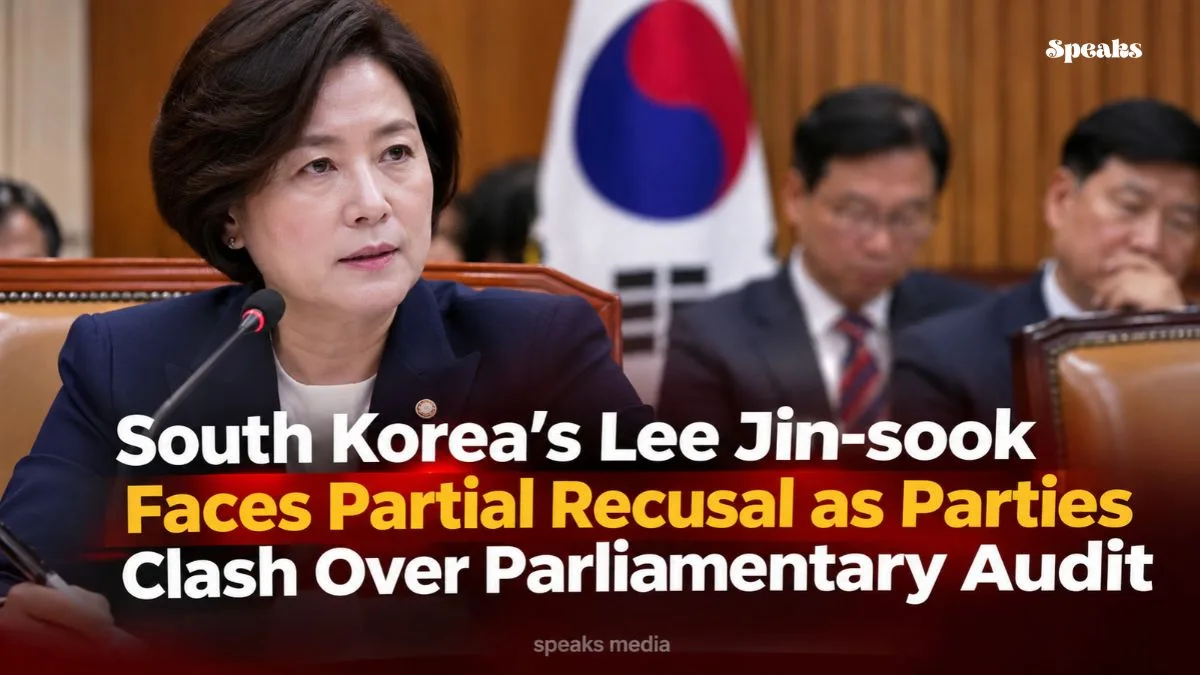
South Korea’s ruling and opposition lawmakers clashed on October 22 after the Constitutional Court partially blocked a parliamentary measure excluding People Power Party lawmaker Lee Jin-sook from legislative audits. The decision has intensified a political dispute over fairness, oversight and the limits of lawmakers’ participation.
The court’s interim ruling, issued on October 21, rejected a blanket ban on Lee attending audits involving broadcasting-related agencies. However, it maintained restrictions on her participation in matters directly connected to her previous tenure as chairperson of the Korea Communications Commission.
Constitutional Court Limits Scope of Lee Jin-sook’s Exclusion
The dispute centers on whether Lee should be allowed to take part in parliamentary scrutiny of public institutions when some questions concern her own past decisions and conduct.
The Democratic Party argued that the court’s decision reinforced the principle that lawmakers should not act as both participants in a dispute and judges of matters involving themselves. Democratic Party lawmaker Lee Jeong-heon summarized the position by saying that “a player cannot be a referee.”
People Power Party lawmakers rejected the ruling bloc’s demands that Lee leave the audit room. They called for an apology over the original exclusion measure, which was passed on October 12 and broadly restricted her participation.
Recusal Dispute Triggers Fresh Political Confrontation
The disagreement highlights the wider debate over recusal, a process intended to prevent people from participating in decisions where personal involvement or a potential conflict of interest could undermine impartiality.
In this case, the court drew a distinction between a comprehensive exclusion from broadcasting-related audits and restrictions on proceedings directly involving Lee’s former role at the Korea Communications Commission.
People Power Party lawmaker Kim Jang-kyom accused the ruling bloc of suppressing opposition lawmakers’ ability to speak. His party argued that the broad restrictions had unfairly limited Lee’s participation and demanded an apology from the Democratic Party.
Lee also challenged the ruling bloc, arguing that Democratic Party lawmaker Han Jun-ho should face similar restrictions over questions involving his own office and an alleged instance of external pressure. Han denied the allegation, calling Lee’s claims false.
Dispute Over Filming Adds to Tensions Inside Audit Room
The confrontation escalated when an aide to Lee stood near Democratic Party lawmakers’ seats and filmed the proceedings on a mobile phone. Democratic Party lawmaker Kim Hyun objected, arguing that the recording was interfering with legislative activities.
Lee responded that the aide had the right to take videos or photographs, prompting further exchanges between lawmakers.
The parliamentary audit covering KBS and online platforms also faced delays. Lawmakers began their main questioning about an hour after the session opened, reflecting the extent to which the political dispute had disrupted proceedings.
The court’s partial ruling leaves Lee eligible to attend audits outside matters directly related to her previous tenure, while preserving restrictions on her participation in those specific issues. The disagreement between the parties continued during the October 22 session.