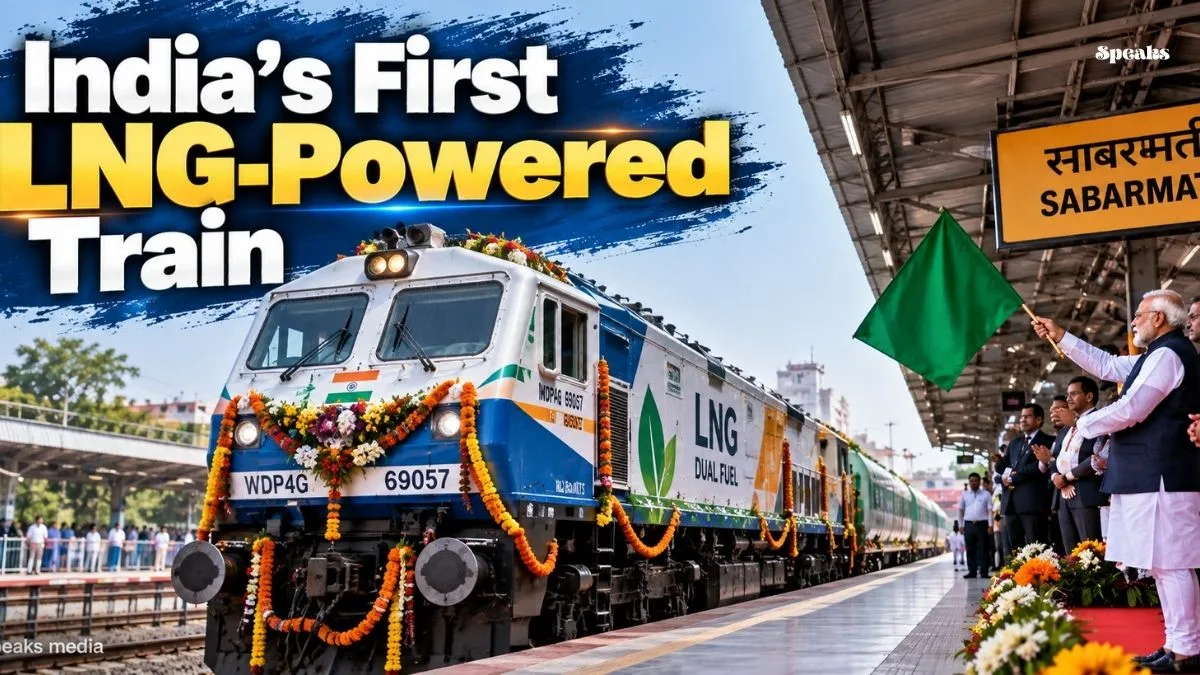
India has entered a new phase in railway fuel technology with the launch of its first LNG-powered train. Union Home and Cooperation Minister Amit Shah flagged off the train from Sabarmati Railway Station in Gujarat on September 27, 2026. The train uses a diesel-LNG dual-fuel system designed to reduce reliance on conventional diesel.
The train is not powered exclusively by liquefied natural gas. Instead, its engine can operate using both LNG and diesel, depending on fuel availability. This dual-fuel setup allows railway operations to continue without depending entirely on one energy source while also creating an opportunity to reduce diesel consumption.
Before its public launch, the technology underwent field trials covering around 2,000 kilometres. The trials were conducted to assess the performance of the converted system and its suitability for regular railway operations. According to reports, LNG can replace up to around 40% of diesel consumption in the dual-fuel system.
The LNG train project is aimed at lowering fuel consumption and reducing emissions from railway operations. The use of LNG is expected to help reduce carbon dioxide, nitrogen oxides and particulate emissions compared with conventional diesel operation. It also has the potential to reduce fuel costs over the long term.
The train uses two Driving Power Cars, each with a capacity of 1,400 horsepower, which were converted to operate on the diesel-LNG combination. The technology therefore allows the same power units to use either fuel, providing operational flexibility while railway authorities assess the wider potential of LNG-based propulsion.
The inaugural service is an eight-coach, non-air-conditioned chair car train. During its first run, the train operates between Sabarmati and Mahesana. A regular route for the LNG-powered train has not yet been finalised, according to details reported on the launch.
The project is part of a broader set of railway initiatives launched in Gujarat on September 27. Along with the LNG train, projects involving a WAG-12 locomotive maintenance facility, the Kavach automatic train protection system, automatic signalling and the doubling of the Sabarmati-Sarkhej railway line were also launched. The combined value of the projects is more than ₹1,500 crore.
The LNG project comes as Indian Railways explores alternatives to conventional fossil-fuel use. The national transporter has also been working on other emerging technologies, including hydrogen-powered trains. The first hydrogen train has begun operations on the Jind-Sonipat route in Haryana, while further routes are being considered.
The introduction of the first LNG-powered train does not mean that diesel trains are being immediately replaced across the railway network. For now, the dual-fuel system is being introduced as an alternative technology, with the results of its operation expected to provide further information about its fuel savings, emissions performance and wider use in the future.