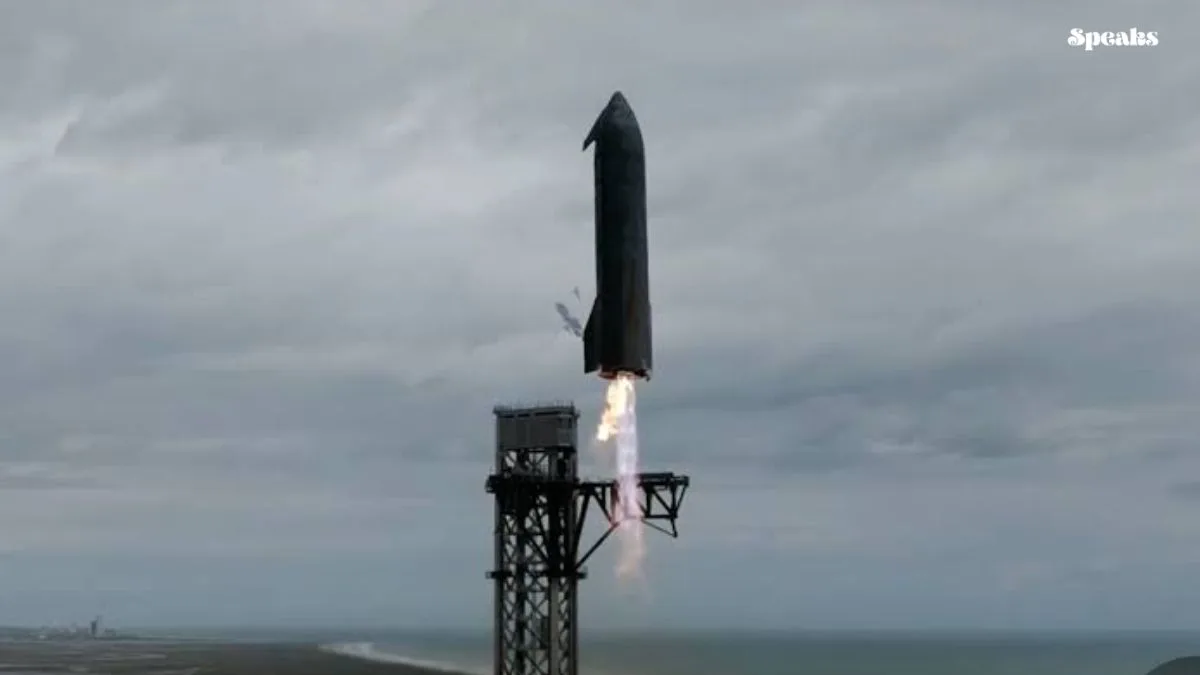
Starbase, Texas: SpaceX has achieved a major milestone in rocket technology after its Starship spacecraft successfully returned to its Texas launch site and was caught by giant mechanical arms on Saturday, November 14. The achievement marks a significant step toward fully reusable rockets.
The 171-foot-tall spacecraft completed a mission lasting approximately 22.5 hours, traveling around Earth 14 times before returning to the same launch facility from which it departed. The successful recovery demonstrated a new capability in SpaceX’s ambitious rocket development program.
The spacecraft launched on Friday, November 13, from SpaceX’s Starbase facility in South Texas. During its journey, Starship reached an altitude of approximately 161 miles above Earth and deployed 26 Starlink satellites into orbit.
After completing its orbital mission, the spacecraft began its return journey by firing one of its engines to initiate atmospheric reentry. It encountered extreme temperatures as it entered Earth’s atmosphere at speeds of approximately 17,000 miles per hour.
As the vehicle descended toward Starbase, its engines reignited to control its movement and position. The spacecraft flipped into a vertical orientation before slowly approaching the launch tower for its final recovery maneuver.
In a remarkable moment, two enormous mechanical arms, commonly known as chopsticks, caught the descending spacecraft as it hovered above the launch pad. The vehicle remained suspended between the arms after its engines shut down, completing a major recovery test.
The successful SpaceX landing represents an important engineering achievement because the company aims to recover and reuse its entire rocket system rather than discard expensive hardware after every launch.
However, the mission did not achieve a complete recovery of both rocket stages. The Super Heavy booster, which carried Starship into space, failed to return to the launch tower approximately 10 minutes after liftoff.
The booster encountered a navigation-related problem during its return attempt and was diverted away from the launch pad. This prevented SpaceX from completing its first planned recovery of both the Super Heavy booster and Starship during the same mission.
Despite the booster setback, the successful recovery of the upper-stage spacecraft marked a significant development in the company’s reusable rocket technology. It also demonstrated that Starship could complete an extended orbital mission and return to its original launch location.
SpaceX has spent approximately $15 billion developing Starship over the past decade. Company founder Elon Musk sees the massive spacecraft as a central part of its future satellite operations and long-term plans for human space exploration.
The rocket is expected to play an important role in expanding the Starlink satellite network, supporting potential orbital data centers and eventually transporting astronauts and cargo to the Moon and Mars.
Unlike SpaceX’s Falcon 9 rocket, which has a reusable first stage but discards its upper stage after launch, Starship is designed to make both stages recoverable. The company wants the system to operate with a frequency similar to commercial aircraft.
However, important technical challenges remain. Starship’s heat shield, made up of thousands of protective black ceramic tiles, still requires improvements to reduce damage during atmospheric reentry and limit refurbishment between flights.
SpaceX is developing improved heat-shield designs that could make the spacecraft easier to inspect and prepare for subsequent missions. Achieving rapid turnaround times will be essential to the company’s long-term plans for frequent launches.
The successful mission also carries significant importance for NASA’s Artemis program. The US space agency has committed approximately $3.2 billion toward SpaceX’s Starship lunar lander development contract, which is valued at more than $4 billion.
NASA plans to use a version of Starship to transport astronauts to the lunar surface during future Artemis missions. The spacecraft must demonstrate additional capabilities, including transferring fuel between vehicles in orbit, before it can support its planned lunar operations.
NASA is targeting crewed lunar missions beginning in 2028, making Starship’s development an important part of its broader Moon exploration strategy.
SpaceX’s latest achievement demonstrates progress toward recovering spacecraft directly from orbit, although the company still needs to prove that both rocket stages can be recovered and reused reliably across repeated missions.