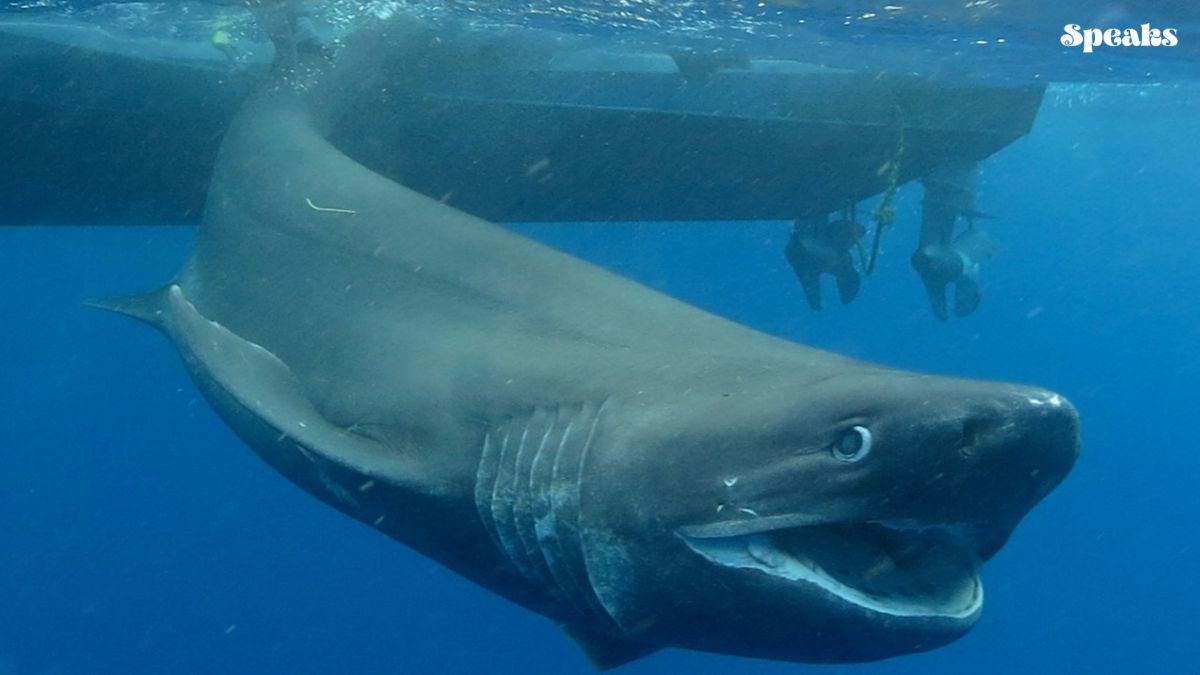
A remarkable underwater encounter involving a giant shark is attracting renewed attention after footage showed the animal approaching a research submersible and pressing its snout against the viewing window.
The female shark, estimated to measure between 16 and 17 feet, came face-to-face with researchers approximately 1,700 feet beneath the Atlantic Ocean near the Bahamas.
The footage captures the enormous predator slowly circling the underwater vessel before moving directly toward the scientists. Its close approach offered researchers an unusual opportunity to observe one of the ocean’s least frequently encountered predators.
The animal was identified as a bluntnose sixgill shark, a deep-water species capable of reaching lengths of approximately 20 feet. Unlike many familiar shark species, sixgills spend much of their lives far below the ocean’s surface.
Although the footage has recently circulated widely on social media, the encounter itself is not new. It dates back to June 2019, when researchers working with marine exploration organization OceanX conducted an expedition in the waters of Exuma Sound.
The mission had an important scientific objective: successfully attach a satellite tracking device to a bluntnose sixgill shark without bringing the animal to the surface.
Previously, researchers studying these sharks often had to capture them and transport them toward the surface to attach tracking equipment. That process can cause stress and potentially interfere with their natural behavior.
For the expedition, scientists used OceanX’s three-person research submersible, Nadir, which descended into the deep Atlantic waters. The team carried approximately 100 pounds of bait to attract sharks during the operation.
The researchers faced several unsuccessful attempts because of difficult weather, technical problems and unexpected interruptions during the expedition. However, they eventually achieved their primary objective on June 29, 2019.
According to the Florida Museum of Natural History, scientist Gavin Naylor successfully attached a satellite tracking tag to a male sixgill shark more than 1,700 feet underwater.
The achievement marked the first successful tagging of a bluntnose sixgill shark at depth in its natural habitat. It provided researchers with an opportunity to study the species without first bringing it out of the deep ocean.
The enormous female featured in the circulating footage was among several sharks encountered during the same expedition. Her unusual approach gave the researchers an especially memorable experience.
Naylor described the encounter as an example of a shark displaying curiosity toward humans. He explained that the animal appeared to be examining the researchers just as closely as they were observing her.
Bluntnose sixgill sharks are particularly interesting to marine scientists because of their ancient evolutionary history. Their lineage resembles sharks that inhabited Earth’s oceans approximately 200 million years ago.
These deep sea sharks typically occupy depths ranging from several hundred feet to thousands of feet below the surface. Some individuals have been documented at depths approaching 6,500 feet.
Despite their intimidating appearance and considerable size, bluntnose sixgill sharks are not generally considered a significant threat to humans. Their natural environment is far removed from the coastal waters where most recreational swimmers encounter sharks.
Their diet includes fish, squid and other marine animals, and they are also known to feed on larger carcasses when opportunities arise.
The 2019 expedition demonstrated how advanced underwater technology can help researchers study elusive marine predators in their natural environments without relying entirely on traditional capture methods.