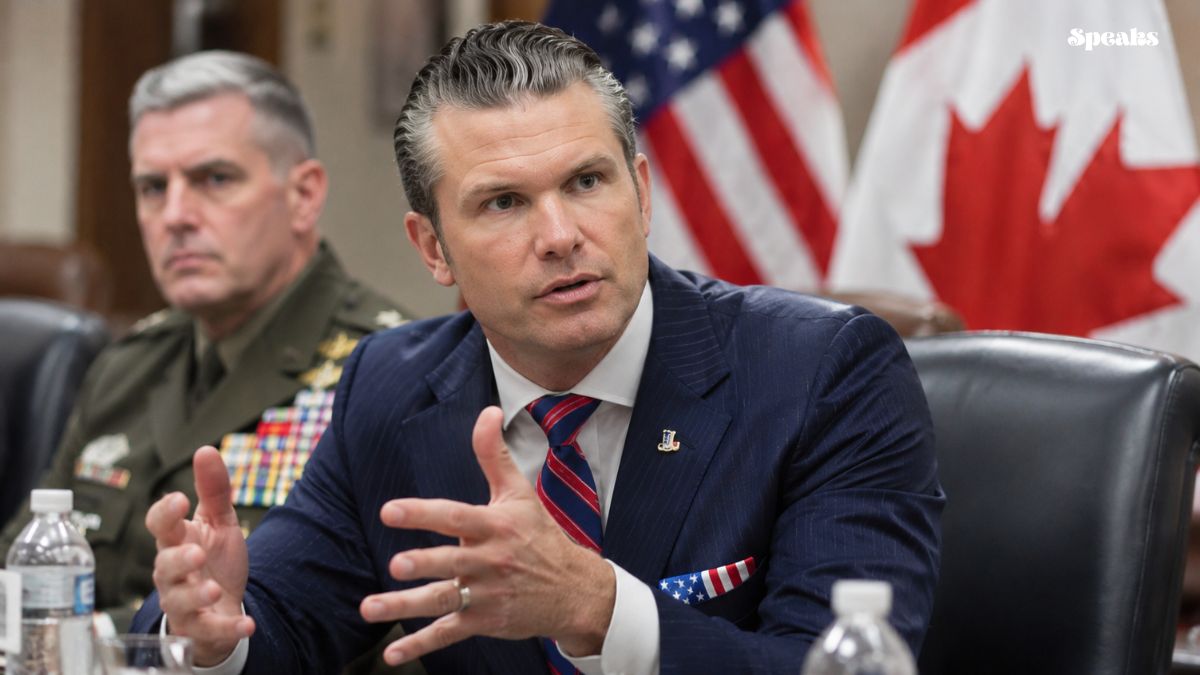
U.S. Defense Secretary Pete Hegseth has reportedly introduced new restrictions on the military relationship between the United States and Canada through a classified Pentagon directive, raising fresh questions about one of North America’s longest-standing defense partnerships.
The Washington Post reported on November 20 that Hegseth circulated the memo the previous week, citing officials familiar with the directive. The newspaper said the restrictions were not fully detailed, leaving uncertainty over which military activities could be affected.
The development comes amid growing tensions between Washington and Ottawa over trade, defense spending and President Donald Trump’s repeated comments about making Canada the 51st U.S. state.
However, the Pentagon has said the directive will not affect intelligence sharing or cooperation through NATO and the North American Aerospace Defense Command, known as NORAD.
What Do the US-Canada Military Relationship Restrictions Mean?
The reported directive signals a possible change in how the Pentagon manages day-to-day defense engagement with Canada.
Officials familiar with the memo told The Washington Post that new limits had been introduced, but the exact scope of the restrictions was not publicly established. The newspaper also reported that it had not reviewed the classified document itself.
That distinction matters because the announcement does not amount to a complete suspension of military cooperation between the two countries.
It remains unclear whether the directive affects military exchanges, joint planning activities, training programs, defense meetings or other forms of bilateral engagement.
Pentagon spokesman Sean Parnell said the department is reviewing its engagements to ensure cooperation with Canada advances concrete U.S. defense objectives.
He also said Washington is prioritizing cooperation that strengthens the defense of North America and supports Canada’s ability to meet its NATO commitments.
Pentagon Says NORAD and NATO Cooperation Will Continue
One of the most important details in the Pentagon’s response concerns the defense arrangements that will remain unchanged.
Parnell said the reported guidance does not affect defense intelligence cooperation, the countries’ binational NORAD command or their military cooperation through NATO.
NORAD is a joint U.S.-Canadian defense organization responsible for aerospace warning, aerospace control and maritime warning across North America.
The command plays a central role in monitoring potential threats to the continent. Its operations depend on coordination between military personnel, surveillance systems and defense authorities from both countries.
The Pentagon’s clarification indicates that the reported restrictions do not represent a withdrawal from these core defense arrangements.
However, the distinction between protected joint operations and other bilateral military activities remains important. The exact areas covered by the classified directive have not been publicly explained.
Canadian Military Officials Say Cooperation Is Operating Normally
A separate report by The Globe and Mail added an important Canadian perspective to the developing story.
Three Canadian military sources told the newspaper that senior Canadian Armed Forces leaders were unaware of the reported memo until they learned about it through The Washington Post’s coverage.
The sources also said the Canadian government and military had received no formal or informal communication from Washington about plans to reduce defense cooperation.
Two senior military sources said military-to-military relationships were operating normally and that Canada intended to continue its existing approach.
The Canadian sources reportedly suggested that military exchange programs could be among the areas potentially affected, although no confirmed list of restricted activities has been released.
The contrasting accounts leave an important question unanswered: whether the directive will produce practical changes in military operations or mainly alter how the Pentagon approves and prioritizes future engagements.
Why Are US-Canada Defense Relations Under Pressure?
The reported restrictions arrive after months of disagreements between the Trump administration and the government of Canadian Prime Minister Mark Carney.
Trump’s repeated remarks about Canada becoming part of the United States have created diplomatic friction. Trade disputes and tariffs on Canadian goods have added further pressure to the relationship.
Ottawa has responded to U.S. trade measures with retaliatory tariffs and has increasingly discussed reducing its dependence on American defense suppliers.
Defense spending has also become a major point of disagreement between the two governments.
The Trump administration has pushed Canada to increase military investment and strengthen its ability to contribute to NATO’s collective defense commitments.
Canada reached NATO’s previous target of spending 2% of gross domestic product on defense and has committed to the alliance’s newer spending goals.
The Pentagon has nevertheless questioned whether Canada’s plans provide enough detail about how it will meet its longer-term defense commitments.
Canada’s F-35 Fighter Jet Review Adds to Defense Tensions
Canada’s military procurement decisions have become another sensitive issue in its relationship with Washington.
The Canadian government has been reviewing its planned purchase of 88 F-35 fighter jets from Lockheed Martin, a U.S. defense contractor.
The review has raised concerns in Washington because the aircraft program represents a major part of Canada’s future military modernization plans.
Canada’s interest in examining alternative defense partnerships reflects a broader effort to strengthen domestic military capabilities and reduce reliance on a single foreign supplier.
However, changing fighter procurement plans would involve significant financial, operational and technical challenges.
The F-35 program is also connected to a wider network of allied maintenance, training, logistics and military interoperability arrangements.
The reported Pentagon directive has therefore emerged at a time when both countries are reassessing parts of their long-term defense relationship.
Five Eyes Intelligence Sharing Remains a Key Issue
The United States and Canada are also members of the Five Eyes intelligence-sharing alliance, alongside the United Kingdom, Australia and New Zealand.
The partnership allows member countries to exchange intelligence and cooperate on security issues. It has played an important role in defense and intelligence coordination for decades.
According to The Washington Post’s reporting, an official from one of the Five Eyes countries said Washington had not formally announced a change to intelligence sharing with Canada.
However, the official also said U.S. officials had shared less information across several platforms during the previous year.
The Pentagon’s statement specifically said the new guidance would not affect defense intelligence cooperation.
There is currently no publicly confirmed evidence that the reported memo has formally removed Canada from Five Eyes arrangements or ended intelligence sharing between the two countries.
US and Canada Have Decades of Military Cooperation
The United States and Canada have maintained an extensive defense partnership for generations.
Both countries are founding members of NATO and have worked together through NORAD since the command was established in 1957.
Their military relationship includes joint air defense, intelligence cooperation, military exercises, personnel exchanges and coordination on threats affecting North America.
Canadian forces have also served alongside American troops in international military operations, including deployments in Afghanistan.
The close relationship is supported by geography as well as shared security interests. The two countries share an approximately 8,891-kilometer land border and face common challenges involving aerospace security, maritime approaches and emerging threats.
Any sustained reduction in military engagement could therefore have implications beyond diplomatic relations, particularly if it affects coordination between defense institutions.
What Happens Next After Hegseth’s Classified Memo?
The immediate question is whether the Pentagon will provide further details about the directive and explain which areas of cooperation will be subject to new restrictions.
The memo itself has not been made public, and officials have not provided a complete description of its requirements.
Canadian military sources have said existing military-to-military relationships are continuing normally. The Pentagon, meanwhile, has emphasized that NORAD, NATO cooperation and defense intelligence sharing will remain unaffected.
The governments have not publicly confirmed a comprehensive suspension of bilateral military cooperation.
Further clarification from Washington and Ottawa will be important in determining whether the directive represents a limited administrative change or a broader shift in the defense relationship.